Horticulture

The gross value of horticultural industries is estimated at $3.2 billion for 2023-24, up 3.5% year-on-year. Horticultural exports were also stronger, up 18% year-on-year to $340 million in 2023-24. Increased orange production has supported strong export growth in 2023-24 with a 76% increase in the volume of oranges exported.

Production was supported by continued easing of critical input shortages and associated costs through 2023-24, including some improvement in seasonal labour availability and moderating of prices for some fertiliser and agricultural chemical inputs.

At the date of publication, industry information for 2023-24 is generally limited to trade data and some price data, while other detailed production information is not available, consequently the following production and price commentary analyses 2022-23 industry data, unless otherwise stated.

Value of Horticultural Output 2022-23 au

  • Nurseries, Cut Flowers & Turf
  • Cut flowers
  • Cultivated turf
  • Nurseries
  • Vegetables
  • Potatoes
  • Tomatoes
  • Mushrooms
  • Other vegetables
  • Fruit
  • Blueberries
  • Citrus
  • Table Grapes
  • Apples
  • Other Fruit (Excl. wine grapes)
  • Nuts
  • Almonds
  • Macadamias
  • Other nuts
Source: Horticulture Innovation Australia (2024)

Horticulture trade

The value of horticultural exports in 2023-24 was stronger, up 18% year-on-year to $340 million. While China remained the major export market by value in 2023-24 with a value of $62 million, this was down 4% year-on-year. Exports to Hong Kong offset this decline up $9 million in 2023-24 to $32 million. Other significant export destinations for horticultural produce included South Korea and India which increased substantially year-on-year, by 105% and 91% respectively. South Korea was the second most valuable market in 2023-24 with a value of $40 million. Potatoes, citrus, fresh grapes, and nuts represent the major horticultural exports to South Korea. 79
Exports to India were valued at $21 million in 2023-24 supported by the Australia-India Economic Cooperation and Trade Agreement which has resulted in a reduction, or phasing out over time, of tariffs on a number of key horticulture crops. While India has considerable domestic production of most vegetables, there is interest in a number of key horticultural products including almonds, macadamia, avocadoes, citrus and table grapes, with almond exports increasing 60% to total $16 million in 2023-24. 79

Fruit

The value of fruit production in 2022-23 totalled almost $1.15 billion up 21% on the prior year. 87 au Blueberries and citrus remain the major contributors valued at $361 million and $334 million respectively in 2022-23, with the improved production of citrus and in particular oranges contributing to the lift in the value of fruits produced. Blueberry production increased to just over 17 thousand tonnes, 3% higher year-on year attributed in part due to increased plantings that more than covered the crops lost from the 2022 storms in the Coffs Harbour region. 78

Orange production increased 21% to total almost 316 thousand tonnes over 2021-22 with more favourable, dryer harvesting conditions in key growing areas for late navel production in 2022-23, supporting fruit quality. 86 139 Mandarin production, while relatively small in New South Wales, grew substantially in 2022-23 as new plantings came into production lifting fruit production to 24 thousand tonnes, with a value of $45 million, from just under 3 thousand tonnes the year earlier. Increased production nationally has been observed with mandarin plantings increasing 50% over the last ten years. 86 139 .

Increased orange production through 2022-23 has supported strong export growth in 2023-24 with an 76% lift in volume terms from 2022-23 to total 34 thousand tonnes valued at $59 million. The average export unit price was up 6% year-on-year. 79

Orange production in the short to medium term is likely to be be supported by firmer global pricing, as a result of lower supply from producers such as Florida in the United States and Brazil. These major producing areas have been impacted by a combination of dry seasons and disease resulting in reduced fresh fruit and concentrate supplies. Australia imports about half of its domestic demand for orange juice concentrate, just over 14 thousand kilolitres of frozen or fresh orange juice in 2022-23, with 80% coming from Brazil and 10% from Israel. 86 34 Citrus Australia estimates Australia’s concentrate imports are equivalent to approximately 180,000 tonnes of oranges per annum. 45 With record international concentrate prices, Australian orange producers are likely to benefit from a period of stronger prices in the short and medium term. 34

Among other fruits, avocado production increased by 14% to total 13 thousand tonnes in 2022-23 and gross value increased 86% to $63 million. The national farm gate price avocados for 2022-23 increased 52% to $4,524 per tonne. an 41

Value of top 10 fruits produced, 2022-23

Source: Horticulture Innovation Australia (2024)

NSW orange exports, volume and average unit price

  • Japan
  • China
  • Korea, South
  • Hong Kong
  • Indonesia
  • India
  • United Arab Emirates
  • ROW
  • Average unit export price (RHS)
Source: GTA (2024)

Nuts

NSW nut production, tonnes in shell equivalent

  • Almond
  • Chestnut
  • Hazlenut
  • Macadamia
  • Pecan
  • Pistachio
  • Walnut
Source: Horticulture Innovation Australia (various issues)

Value of NSW nut production

  • Almond
  • Chestnut
  • Hazlenut
  • Macadamia
  • Pecan
  • Pistachio
  • Walnut
Source: Horticulture Innovation Australia (various issues)
The gross value of nut production was substantially lower in 2022-23, down to $159.1 million from the previous year’s $361.8 million. au The large decline was a result of large decreases in both almond and macadamia values and volumes. 86

In the case of almonds, the value produced in 2022-23 was just over $94 million, 42% lower year-on-year, a consequence of a combination of low prices and yields. The Californian almond price reached a low in 2022 of US$1.40 per pound and while recovering slightly in 2023 to US$1.65 per pound, remained lower than the 5-year average of US$2.21 per pound. 142 At the same time production was 27% lower year-on-year to 18.6 thousand tonnes (KWE) in NSW, impacted by cool and wet conditions at critical times. These challenging conditions were also reported to have resulted in lower kernel weights. 124 NSW produced 29% of national production in 2022-23 from almost 12,800 ha of bearing crop. 13 More recently, the 2024 Australian harvest has benefited from dry harvesting conditions in 2024 and is anticipated to return to long terms forecasts and improved quality. 35

The value of macadamia production in 2022-23 was down 42% in 2022-23 from the prior year. 86 The Australian macadamia benchmark price declined 46% year-on-year in 2023 to $1.88 per kilogram ap , and down 72% since the record high price achieved in 2020. 22 . Production was also substantially down in 2022-23 reflecting the wet conditions that impacted growers through the year. Low prices typically result in reduced crop inputs and less intense orchard management practices such as pruning and hedging with subsequent impacts on tree productivity. 23 ). The recent smaller crop and lower local inventories are expected to support pricing for macadamia for the 2023-24 year but remain well below the five-year average prior to 2023. 116

More recently exports of nuts has been mixed. Exports of almonds have continued to increase with 2023-24 exports valued at $36 million, 61% higher than in 2022-23. India and China were the major markets accounting for 51% and 42% of exports respectively. Following an 80% increase in the value of exports to India in 2023-24, India now represents the major market in value terms at just over $18 million. 79 The Australia India trade agreement has resulted in a 50% reduction in import tariffs for both in-shell and kernel and supported increased sales of almonds improving diversification for the Australian industry. 1

Macadamia exports was lower with the value of 2023-24 exports totalling $21 million, 49% lower than the previous year. Exports to China decreased 75% in value terms to $4.6 million while exports to Japan also declined 46% to $6.7 million with Japan representing almost a third of macadamia exports by value. Total export volumes were 38% lower year-on-year to total just over 1,500 tonnes in 2023-24. In volume terms China received the largest share, 506 tonnes or a third of total export volumes, reflecting the lower unit value of macadamia to this market. 79 More subdued demand for macadamia has been linked to more cautious consumers given recent higher costs of living concerns. 116

Vegetables

Vegetable production reached $738.6 million in 2022-23 up 1% year-on-year. au Potatoes, mushrooms and tomatoes each account for about 15% of the vegetable production. While potato production was unchanged on the prior at 159 thousand tonnes year the estimated price per tonne increased by approximately 24%. Mushrooms production was 21% lower in 2022-23 at just over 16 thousand tonnes representing 27% of national production. 86

Tomato production totalled 43 thousand tonnes, 2% lower year-on-year while the estimated price was approximately 20% down year-on-year. 52 % of tomato production in NSW is produced from protected cropping systems, principally glasshouses. 86

Exports of vegetables increased in value terms by 18% year-on-year in 2023-24 totalling $48 million. South Korea, Singapore, Japan and New Zealand were the top four markets, accounting for almost 70 percent of the value of vegetable exports. South Korea the largest export market and valued at $16 million, primarily potatoes valued at $15 million in 2023-24, an increase of 68% over the prior year driven by a 50% increase in volume over 2022-23 to 21 thousand tonnes. 79

Value of top 10 vegetables produced, 2022-23

Source: Horticulture Innovation Australia (2024)

Nurseries, Turf and Floriculture

NSW turf production and average price by species, 2022-23

  • Million m2
  • $/m2 (RHS)
Source: Turf Australia (2024)

Nurseries

The gross value of nursery production in 2022-23 was $833.5 million from 519 businesses. 13 Nationally, retail sales remained the largest market for nursery businesses accounting for 42% of total sales in 2022-23, while wholesale nurseries accounted for 22% and landscape and primary industry sectors representing 14 % and 11% respectively. ‘Big box’ retailers continue to grow as a major market for growers with a third of all production nurseries selling plants to big box retailers in 2022-23, equivalent to almost a quarter of total production nursery sales. 70

Perennials, trees and shrubs category represented the largest share of total national industry sales in 2022-23 at 45%. This includes tree sales which accounted for an estimated 17% of national industry nursey sales. 70

Turf

Turf production was valued at $88.4 million in 2022-23. 86 Turf production for 2022-23 was estimated at 8.45 million square metres 14% lower than the previous year. At the same time the average price of turf by species in 2022-23 was mixed, with species including Buffalo and Kikuyu firmer by 7% and 12% respectively per square metre, while average couch prices were 6 percent lower on the previous year. 137 A number of factors contributed to the reduced production including flooding during 2022-23, while on the demand side housing commencements have slowed through 2023 and into 2024, likely dampening demand for turf products. 14

More recently production of turf was impacted again by some flooding in the Hawkesbury region during April 2024. Although not as substantial as flooding in recent years, the industry is yet to fully recover from prior events. 138

Floriculture

The value of cut flower production in NSW in 2022-23 was estimated at $38.2 million, unchanged from the prior year and represented 12% of national production by value. The majority of production by value, $33.8 million, was grown conventionally across 105 hectares, with an additional 3 ha under glasshouses and 10 hectares utilising polyhouses and tunnels. 86

Exports remain a niche market totalling just under $1 million in 2023-24, compared with imports of floriculture products which were valued at $29 million. The value of NSW imports were 23% lower year-on-year, while national imports were 6% lower. Imported flowers tend to be lower value and include high volume supermarkets sales. 79 The discretionary nature of cut flower purchases mean that demand is likely to be impacted by economic conditions that see consumers limit expenditure.


DPIRD Initiatives in Focus

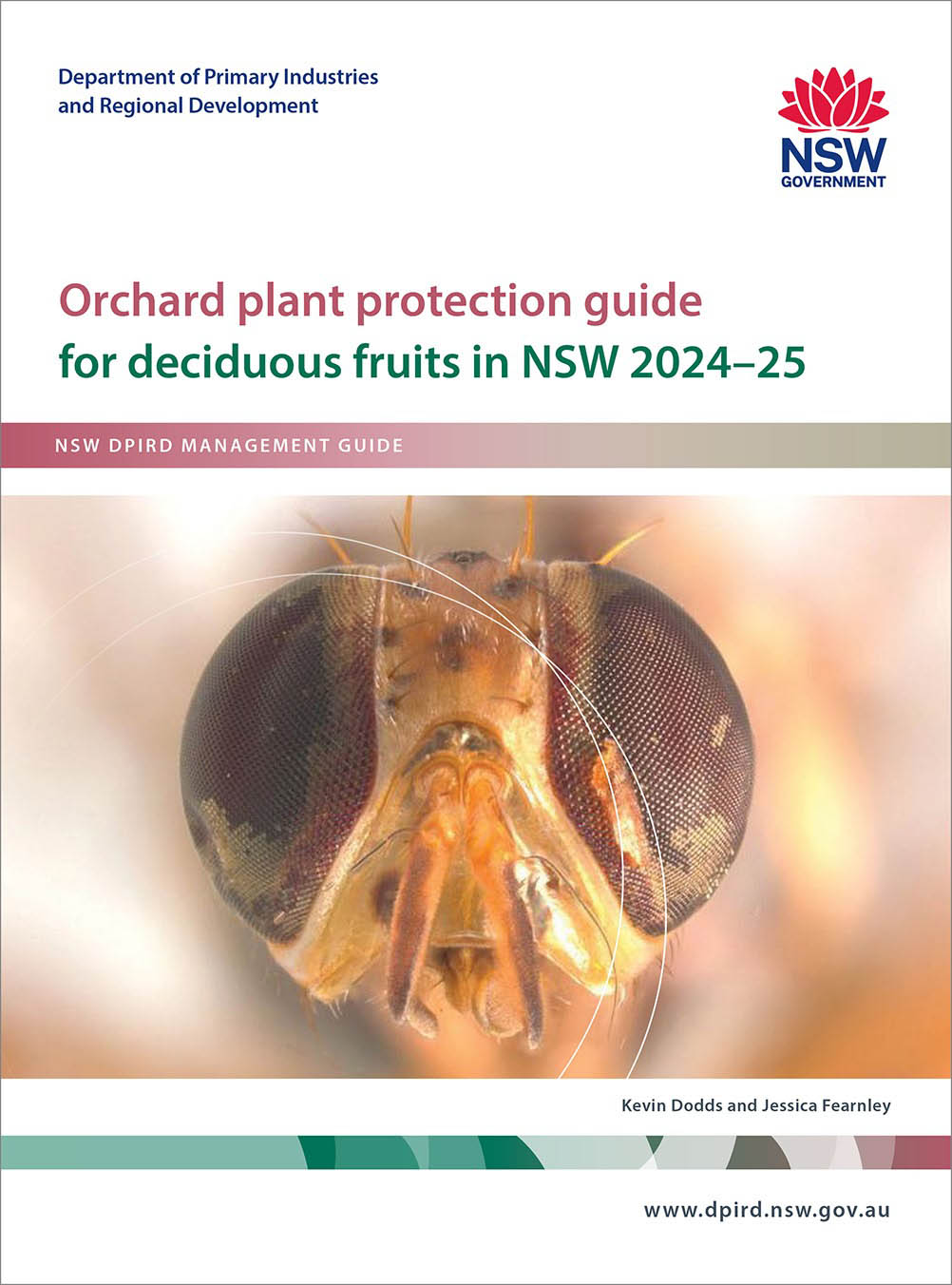
Orchard plant protection guide for deciduous fruits in NSW 2024-25

The 2024–25 edition of the Orchard plant protection guide for deciduous fruits in NSW is the latest annual publication supporting the pest and disease management decisions of NSW temperate fruit producers.

Orchard

The Orchard plant protection guide for deciduous fruits in NSW was published at the beginning of September.

The 2024–25 edition of the Orchard plant protection guide for deciduous fruits in NSW is the latest in a series of annual publications that have supported the pest and disease management decisions of generations of NSW temperate fruit producers for over 60 years. The guide is recognised as a respected and valuable reference for temperate fruit industries.

Feature articles:

  • Aphrika Gregson, Farm Chemicals Officer at NSW DPIRD, provides an update on Australian Pesticides and Veterinary Medicines Authority (APVMA) chemical reviews relevant to deciduous fruits in NSW. Her article includes details of APVMA reviews for active ingredients, including the insecticides chlorpyrifos, malathion, diazinon, fenitrothion and fipronil and the herbicides diquat and paraquat.
  • Jess Fearnley outlines the new NSW DPIRD-led Hort Innovation project ‘Extension and communication for the Australian cherry industry (CY22002).
  • Kevin Dodds explores the evolution of orchard sprayers from labour-intensive horse-drawn machines to modern tower sprayers. His article highlights the development of the next generation of narrow orchards as the catalyst for more targeted and efficient approaches to spray application.
  • Climate scientists and entomologists predict that climate change and associated temperature shifts will affect the distribution and activity of certain agricultural and horticultural pests. The NSW DPIRD Climate Vulnerability Assessment provides an overview of the findings for Queensland fruit fly and discusses the implications for temperate fruit-producing districts of NSW by 2050.

Click here for your copy of the Orchard plant protection guide for deciduous fruits in NSW 2024-25.