
Primefact 1228, Third edition, May 2026 
Cedar apple rust (Gymnosporangium juniperi-virginianae) is an exotic plant pest not present in Australia. This disease is a serious threat to Australia’s apple industry.
Cedar apple rust is a fungal disease caused by Gymnosporangium juniperi-virginianae that causes lesion development in apples.
The cedar apple rust fungus has two hosts. The fungus must spend part of its lifecycle on cedar trees (Juniperus virginiana) and part of its lifecycle on apple trees (Malus species).
Cedar apple rust reduces orchard productivity by defoliating apple trees and blemishing fruit.
Notifiable status
If you suspect Cedar apple rust (Gymnosporangium juniperi-virginianae):
- Call the Exotic Plant Pest Hotline 1800 084 881
- Email biosecurity@dpird.nsw.gov.au with a clear photo and your contact details
- Report online: online form
Symptoms
On cedar trees
Small greenish brown swellings appear on the foliage of the cedar tree. These galls enlarge, turn a chocolate brown colour and become kidney shaped as they age. In moist weather mature galls sprout orange protrusions called telial horns (Figure 1).
The telial horns are made of a gelatinous material that swells so that a gall covered with telial horns may reach 6-8 cm in diameter.
On apple trees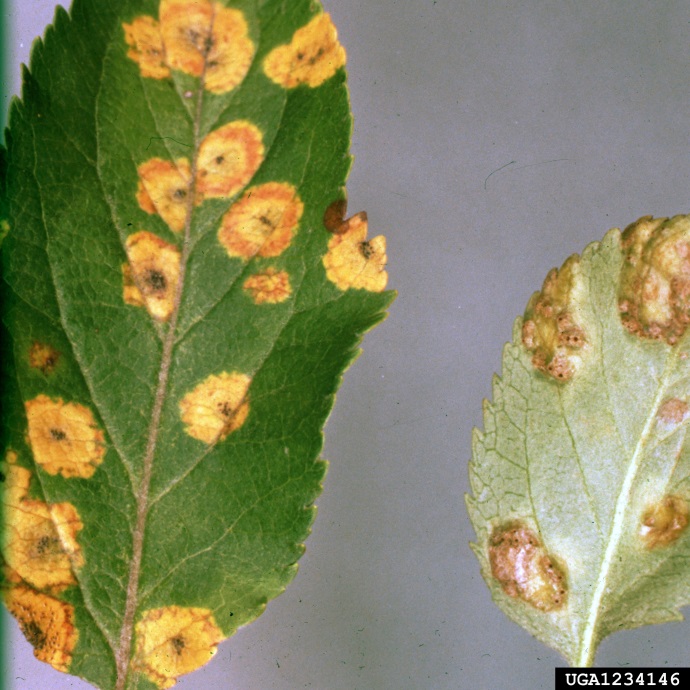
This disease first appears on apple leaves as small greenish yellow spots. The spots gradually enlarge and change colour to orange-yellow. Concentric red bands develop around the spots (Figure 2).
The types of fungal spores produced in the spots on the upper leaf surfaces differ from those produced from spots on the lower leaf surface.
Lesions formed on the underside of the leaf produce hairlike structures which protrude releasing spores. Leaf material thickens around the protrusions making the lesions appear cuplike in shape. These cup shaped lesions can also develop on immature apples. Infected fruit is dwarfed and malformed.
Disease cycle
The disease cycle of the cedar apple rust fungus is complex. Two different hosts, cedar and apple trees, are required for the fungus to complete its lifecycle.
Cedar leaves are infected in summer by spores blown from lesions on apple leaves.
Small greenish brown galls appear the following summer but do not enlarge and mature until the following spring. The large galls on the cedar tree are sometimes called “cedar apples.”
After spring rains occur the galls form gelatinous protrusions. These protrusions (horns) produce spores which are windborne onto apple trees. The fungus establishes on its alternate apple host and completes its lifecycle.
Build-up of the disease within a season in an apple orchard occurs by spores produced on the upper surfaces of apple leaves.
Spread
Spores are windborne and are spread by prevailing winds within and between apple orchards and to the alternate cedar host.
Long distance spread is likely to occur through human assisted movement of infected apple or infected cedar plant material.
Hosts
The primary hosts of cedar apple rust are Malus species especially apple (Malus domestica) and crab apple (M. sylvestris).
The alternate hosts are members of the genus Juniperus which includes eastern red cedar (J. virginiana) as well as many ornamental junipers.
Distribution
Cedar apple rust is endemic to North America.
Actions to minimise risks
Put in place biosecurity best practice actions to prevent entry, establishment and spread of pests and disease:
- practice “Come clean, Go clean”
- ensure all staff and visitors are instructed in and adhere to your business management hygiene requirements
- source propagation material of a known high health status from reputable suppliers
- keep records