
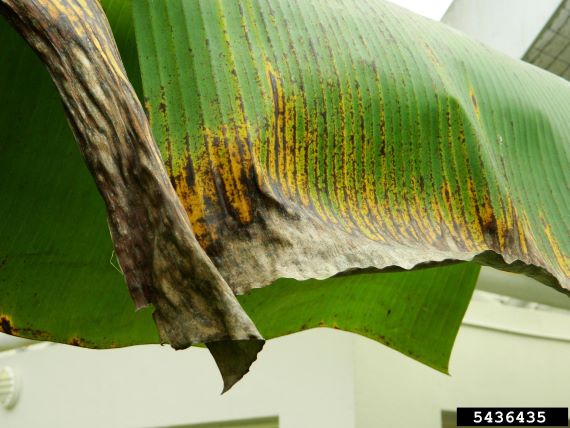

There are six recognised stages in symptom development.
Stage 1 – initial speck stage
Tiny specks less than 0.25 mm appear on the underside of the leaf surface. These specks are white to yellowish in colour and quickly turn reddish brown.
Stage 2 – initial streak stage
These specks elongate and widen becoming streaks which are also small (2mm by less than 1 mm). At this stage the streaks are more visible on the underside on the underside of the banana leaf than on the top side.
Stage 3 – second streak stage
The initial streaks continue to expand in size and change colour from the reddish brown to a very dark brown almost black colour. Where infection is heavy the streaks may overlap which gives infected leaves a black appearance.
Stage 4 – first spot stage
The streaks continue to enlarge and become rounded in shape. They turn brown and a water-soaked border may develop around the edges of the infection. Spots occur on the top surface of the banana leaf.
Stage 5 – second spot stage
The middle of the spot becomes slightly depressed. The water soaked border may develop a yellow halo around it. When infection is heavy large areas of leaf tissue break down.
Stage 6 – third spot stage
The centre of each spot dries out and changes colour to a pale grey or beige. Sexual and asexual fungal spores develop in the dead tissue. A distinctive black border surrounds each spot. Banana leaves die and the spots remain visible on the dead and dried out leaves.
Host range
The main hosts of black sigatoka are culltivated bananas (Musa spp.). Secondary hosts are plantains (Musa paradisiaca) and wild bananas (Musa acuminata).
Spread
Long distance spread occurs through the movement of infected plant material including leaves, nursery stock and fruit. Short distance spread occurs as the fungal spores are dispersed from infected banana plants and debris by wind and rain-splash.
Distribution
Black sigatoka has been recorded in 77 countries in Africa, Central and South America, Oceania, Southeast Asia.
Black sigatoka was detected on several Torres Strait islands between Australia and Papua New Guinea and on the northern tip of Cape York Peninsula in 1981. Black sigatoka disease is regarded as having a restricted distribution in the Torres Strait and remains under official control. Strict quarantine controls prevent movement of banana plants and fruit from the Torres Strait.
Black sigatoka was found in the banana production area at Tully, North Queensland in April 2001 and an emergency response occurred. Black sigatoka was not found in the affected area after November 2001 and the incursion was declared eradicated in October 2005.
Actions to minimise risks
Put in place biosecurity best practice actions to prevent entry, establishment and spread of pests and diseases:
- practice “Come clean, Go clean”
- ensure all staff and visitors are instructed in and adhere to your business management hygiene requirements
- source propagation material of a known high health status from reputable suppliers
- monitor your banana crop regularly
- keep good records
- isolate banana plants or areas where suspect symptoms are observed