
![Adult Asian long-horned beetle [37 mm] on a branch cross section showing extensive tunnelling damage caused by Asian long-horned beetle larvae](https://www.dpi.nsw.gov.au/__data/assets/image/0015/1131027/AsianLonghorn1.jpg "Figure 1 Adult Asian long-horned beetle [37 mm] on a branch cross section showing extensive tunnelling damage caused by Asian long-horned beetle larvae (Image: E. Richard Hoebeke, Cornell University, Bugwood.org)")
![Asian long-horned beetle larva [56 mm]](https://www.dpi.nsw.gov.au/__data/assets/image/0010/1131031/AsianLonghorn2.jpg "Figure 2 Asian long-horned beetle larva [56 mm] (Image: Dennis Haugen, USDA Forest Service, Bugwood.org)")
Damage
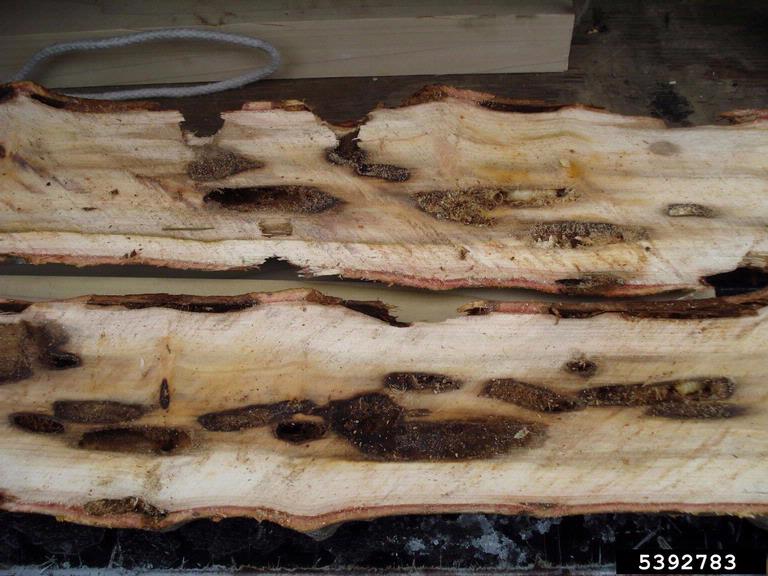
The eggs of Anoplophora beetles are laid into slits in the bark of host plants. Upon hatching, the larvae initially feed in shallow sections of the wood before boring further into the central (heart) wood. In the heartwood they continue to tunnel up and down the tree creating extensive galleries within the branches and trunk. This can cause the death of large branches in otherwise healthy trees.
The damage to internal plant tissues causes plant stress, reduces vigour and increases susceptibility to disease. Timber from infested trees is significantly reduced in value.
Larval tunnel and adult exit holes can be seen in the bark surface (Figure 3). Considerable amounts of frass (sawdust-like poo) (figure 4) and wood shavings are ejected through these large round holes which accumulates at the base of an infested tree.
![Anoplophora beetle exit holes in a host branch [approx. 10-20 mm]](https://www.dpi.nsw.gov.au/__data/assets/image/0018/1131219/AsianLonghorn3.jpg "Figure 3 Anoplophora beetle exit holes in a host branch [approx. 10-20 mm] (Image: Dennis Haugen, USDA Forest Service, Bugwood.org)")
Life cycle
Asian and citrus long-horned beetle adults are sexually mature around 10 days after emerging from their pupa and fly readily in search of a mate. Mating occurs on the trunks and main branches of host trees.
Around one week after mating occurs the females deposit singular eggs in T-shaped slits in the bark of a living tree, several centimetres from the ground. The number of eggs laid per female varies with species and environment. There have been records of 190 eggs per female in Japan.
The lifecycle rate is variable with environment but generally slow, with one generation taking 1–2 years. On hatching from the eggs, larvae tunnel into the trunk to feed. A non-feeding period follows and lasts several months before larvae undergo pupation inside the wood.
When the adult emerges, it chews an exit hole about 25 cm above the original egg laying site. The adults live for about a month.
Hosts
Hosts of Asian and citrus long-horned beetles include a variety of woody plant species.
Both Asian and citrus long-horned beetles are known to attack ash, birch, elder, elm, maple, poplar, rose, sycamore and willow species, as well as commercial stonefruit, apple and pear trees.
Citrus long-horned beetle is also known to attack alder, ash, beech, cedar, chestnut, citrus, fig, guava, lychee, mulberry, oak, pecan, pine, plane, she-oak, walnut and wattle.
Spread
Natural, localised spread of Asian and citrus long-horned beetles is slow. The adult beetles can fly 30 to 225 m in a single flight, though most move only short distances.
Long distance spread of Asian and citrus long-horned beetles mostly occurs with eggs or larvae transported in the wood of host materials or timber packaging. Introduction to Europe and USA has also occurred on bonsai host plants.
Distribution
The natural origin of Anoplophora beetles occurs in Asia, with primary distribution across China, Japan and Korea.
Both Asian and citrus long-horned beetles have previously been detected in a number of countries across Europe, though the majority of these detections have been eradicated or restricted.
Asian long-horned beetle is similarly known to have restricted distribution in Canada and USA.
Actions to minimise risk
Put in place biosecurity best practice actions to prevent entry, establishment and spread of pests and diseases:
- practice “Come clean, Go clean”
- ensure all staff and visitors are instructed in and adhere to your business management hygiene requirements
- monitor your crops regularly
- monitor and control weeds that can harbour the pest
- source plant material of a known high health status from reputable suppliers
- keep records