
Dairy
Dairying forms a significant agricultural activity in NSW, with NSW being the second largest dairy-producing state in Australia. In the 2024-25 financial year, dairies in NSW produced over 1 billion litres of milk, contributing 12.8% of Australia’s milk production. Most dairy farms located on the mid-north and far south coasts. As of 2025, there were a total of 443 licenced dairy farms in NSW, with an average milking herd size of 343 cows.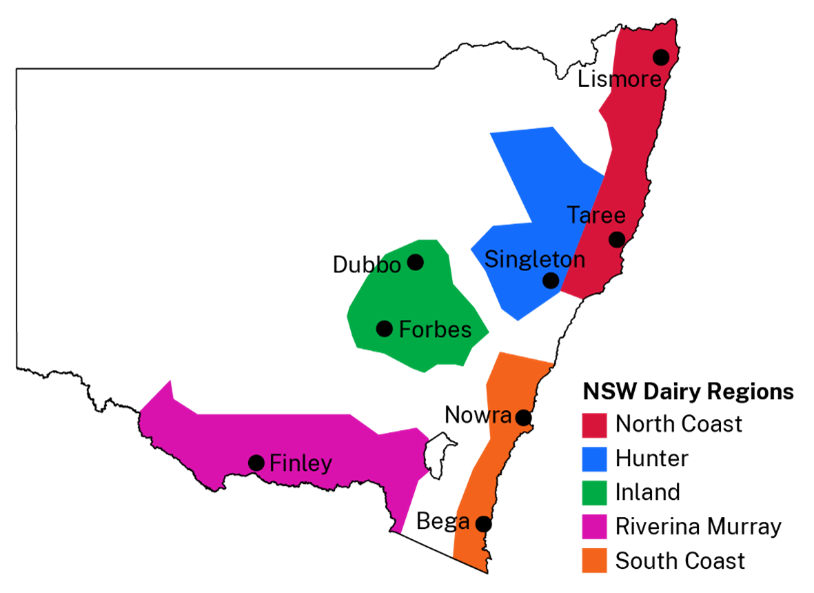
The dairy industry is spread widely across different climates in NSW, from the subtropical climate of Lismore to the semi-arid conditions of Finley. Driven by the geographical diversity of the industry, we divided the dairying regions into 5 key dairy production regions to reflect the different production systems, herd structures and climate conditions found across the state. Our analysis focused on these regions to ensure that the climate vulnerability assessments would be regionally relevant and aligned with the climatic conditions prevailing in places where dairy production is most concentrated in NSW
Climate Vulnerability Assessments
For the dairy industry, the selected commodities were:
- Dairy cows
- Dairy pastures (kikuyu, white clover, ryegrass, lucerne, forage oats and chicory)
Visit each page for more information about the commodity and to view their factsheets and results reports.
Results
The Climate Vulnerability Assessment modelled the historical and future climate suitability for each commodity across NSW. These assessments considered the change in suitability between the historical baseline (1981-2010) and future projections (2036-2065) time periods, reported separately for two emissions scenarios.
Maps of historical and future climate suitability for dairy cows and dairy pastures were produced. These help us to identify where in NSW dairy cows and their key pasture species are likely to thrive or else to be limited by future climatic conditions. The maps will be provided in the upcoming dairy results reports; the factsheets below list important impacts and provide interpretation of the drivers behind changing climate suitability.
Care should be taken when interpreting these findings. The Climate Vulnerability Assessment is intended to highlight potential changes in future climate suitability at industry and regional levels. It is not designed to be interpreted at the scale of individual landholdings.
Regional Factsheets
Our analysis of the impacts of future climate change are presented regionally for both dairy cow and pastures. Please choose the region you are interested in to see those results. For an overall view of dairy cow or dairy pastures, please refer to the upcoming results reports. These will be available online shortly.
North Coast Dairy Region
To be released in 2026.
Hunter Dairy Region
To be released in 2026.
Inland Dairy Region
To be released in 2026.
Riverina Murray Dairy Region
To be released in 2026.
South Coast Dairy Region
To be released in 2026.
Approach
The Climate Vulnerability Assessment required a modelling approach that could be rapidly and consistently applied to different commodities and biosecurity risks to produce consistent and comparable models. To this end, a framework was developed which combined research literature, the knowledge of industry experts and climate data in a modelling approach known as ‘multi-criteria analysis’ (MCA). The resulting MCA models were used to evaluate the suitability of the climate in NSW for the selected primary industry commodities and related biosecurity risks.
For more information on the modelling approach, model assumptions and exclusions, please refer to the results reports. For a detailed description of the methodology and data used in the Climate Vulnerability Assessment, please refer to the methodology summary page and the Climate Vulnerability Assessment Methodology Report.
References
NSW DPIRD, 2025, NSW Dairy Industry Overview.
Funding
The Storm and Flood Recovery Program – Dairy Sector Recovery and Resilience project was funded by the Australian and NSW Governments' Storm and Flood Recovery Program.
Contact us
For more information, please get in touch with vulnerability.assessment@dpird.nsw.gov.au