

Seagrass
Seagrasses are flowering plants that grow underwater in sediment. They are not common on the NSW open coast due to strong waves and sand movement.
However, Cook Island provides protection from the predominant south-easterly and easterly swell, allowing seagrasses to grow on the northwestern and southwestern sides of the island.
Paddle weed (Halophila ovalis) dominates, often growing with dense macroalgae. Mixed paddle weed and eel grass (Zostera muelleri) patches are also present.

Read more
The area and density of seagrass fluctuate with environmental conditions, e.g. when water quality deteriorates from Tweed River flooding, blocking sunlight.
To the northwest, seagrass grows on sandy patches between algae-covered boulders at water depths around 7 to 9 m. Larger, denser and more continuous areas of seagrass grow at a similar depth on the southwest side of the island along the edge of the rocky reef.
Marine life
Seagrass habitat supports a diverse food web above and below the ground. Small fish and invertebrates hiding in and algae growing on the seagrass blades provide food for many larger crustaceans, molluscs and fishes, including yellowfin bream, tarwhine, leatherjackets, trevally and rays.
Green sea turtles forage in seagrass habitat, feeding on seagrass and algae.
Seagrass beds can also support algal communities, with some macroalgae species, like forkweed (Dictyota sp.) growing directly in sand among the seagrass, while others can anchor to seagrass roots.

Mixed foliose macroalgae and seagrass meadow
(Photo: Ecological Service Professionals)

School of tarwhine swimming above seagrass
(Photo: Ecological Service Professionals)
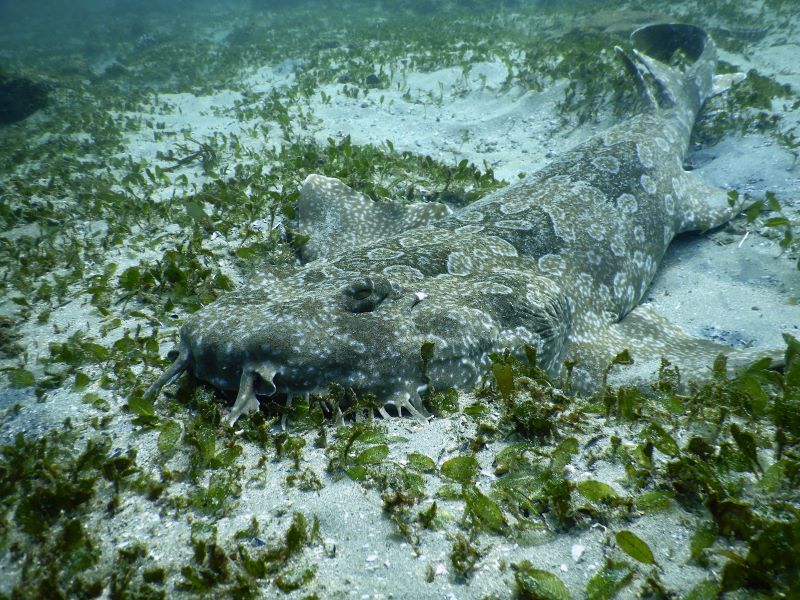
Spotted wobbegong resting among the seagrass (Photo: Ecological Service Professionals)

Green turtle feeding on paddle weed seagrass (Halophila) (Photo: Gary Shuttleworth)

Seagrass is a staple of adult green turtles’ diet
(Photo: Ecological Service Professionals)

Southern grubfish feed on invertebrates that live in the sediment among the seagrass
(Photo: Ecological Service Professionals)

Stars and stripes puffer fish nestled amongst paddle weed (Halophila) seagrass
(Photo: Gary Shuttleworth)

Green turtle feeding in a mixed bed of paddle weed and eel grass
(Photo: Gary Shuttleworth)
