

Queensland fruit fly
Queensland fruit fly (QFF, Bactrocera tryoni) is a significant pest of temperate fruit crops in northern and eastern Australia, including coastal and warm inland districts. It is an important quarantine pest of concern to most importing countries, and often requires end-point treatment control to trade.
Pest identification
Adult QFF are about 6–8 mm long and reddish-brown with yellow markings. Queensland fruit flies are most active in warm, humid conditions and after rain. Adult flies might be seen walking on the undersides of leaves or on maturing fruit, but will take flight if disturbed.

Damage
Queensland fruit flies damage the fruit by inserting their ovipositor and laying their eggs into the skin of the developing fruit (most commonly as the fruit approaches maturity). This is referred to as stinging the fruit and results in a mark on the skin about the size of a match head. In severe infestations, there can be multiple sting marks on each fruit.
When the eggs hatch, the developing larvae burrow into the fruit, causing the flesh to decay. In many instances, the affected fruit can look intact from the outside.


Monitoring
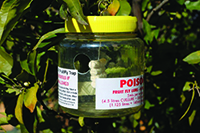
Monitor QFF activity in and around the orchard using a combination of adult fly trapping and visual fruit inspections. Trapping serves as a warning system to indicate when flies are active in the orchard and when to start control treatments. Several types of traps are available including the Lynfield trap, Bugs for Bugs, Bio-Trap, Eco-Lure, Probodelt Cone and McPhail traps.
Lures are available to attract male or female flies, depending on the attractant used. There are also registered and permitted options for making your own chemical lures. Consult your trap supplier for further advice.
Management
Cultural and physical: Queensland fruit fly pupate in the soil under infested trees, making orchard hygiene an important part of managing QFF. Removing and destroying fallen and/or infested fruit from the orchard will help break the cycle and limit the available host material. Fruit fly barrier netting can be used to exclude flies from the crop, but this is not a practical option in commercial-scale orchards.
Mass trapping and male annihilation technique (MAT) cups are also available as non-spray tools to manage adult QFF numbers.

Biological: Queensland fruit fly has several natural predators including the parasitoid Diachasmimorpha tryoni.
Sterile insect technique (SIT) involves mass rearing and sterilising fruit flies that are then released as part of an area-wide management program. Commercial-scale SIT is currently being developed.
Grazing chickens or ducks in the orchard can help reduce pest pressure, but this might only be practical on a small scale.
Chemical: an effective integrated chemical management program for QFF will include trap monitoring, protein bait sprays, male annihilation, orchard hygiene and cover spraying as required. Refer to the Orchard plant protection guide for chemical suggestions.
