

Codling moth
Codling moth (Cydia pomonella) is one of the most damaging pests of apple and pears in Australia. Other hosts susceptible to codling moth include crab apple, some stone fruit, walnut and quince.
Pest identification
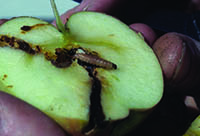
Adult codling moths are approximately 9 mm long with a wingspan of 12–19 mm. Wings are mottled grey, with a brown and gold band at the tip. When the moth is at rest, its wings are held in a tent-like structure over its body. Larvae are white to light pink with a dark brown head. They appear worm-like and are 15–19 mm long. Larvae are most commonly seen when damaged fruit is cut open for inspection.



Damage
A tell-tale sign of codling moth presence is frass (sawdust-like material) at the point where the larvae have entered the fruit. Young codling moth larvae will initially feed just below the skin of the fruit, creating what looks like a small sting on the surface. Most of the damage occurs as the moth tunnels into the fruit and feeds on the flesh and seeds. Bacteria often break down the flesh around the tunnels, causing more internal damage, which can lead to premature ripening and fruit drop. Codling moth larvae feed on the internal parts of the fruit and can damage almost an entire crop if not discovered and controlled.
Management
Cultural and physical: where possible, infested fruit (either in the tree or fallen) should be removed from the orchard and destroyed. It can also be moved to the inter-row and mulched.
Scraping loose bark from trees removes overwintering sites. Take preventative action by burning old tree stacks during re-establishment and before moths emerge in spring. Timber fruit bins can also harbour overwintering codling moth pupae and are a source of infestation and transfer between orchards. Store bins away from orchard blocks if possible.
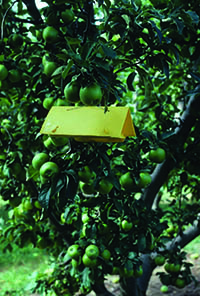
Biological: various biological measures help with managing codling moth and the effectiveness of these depends on the size of the orchard block. For larger blocks or where area-wide management is being practised, mating disruption can be a good alternative to spraying. This technique uses commercial dispensers to emit massive amounts of female moth pheromones into the orchard. This confuses male moths, which are then unable to find female moths to mate with. For smaller blocks (or to supplement mating disruption), other management strategies might be effective. Pheromone traps and mating disruption dispensers must be deployed before full bloom.
Although natural codling moth predators are not totally effective in controlling populations, they should be encouraged by using softer chemicals where possible.
The parasitic wasp Mastrus ridens was recently released in limited locations in the key apple-growing regions of Australia. The performance of this new biological control agent for codling moth will be assessed over the coming seasons and further releases are planned. It is likely that M. ridens will work best as part of an integrated control program using mating disruption and avoiding broad-spectrum chemicals.

Chemical: codling moth control is achieved by using pheromone mating disruption (PMD) or a chemical spray program. In very high-pressure situations, a combination of PMD and insecticide might be necessary to reduce a large resident population. Refer to the Orchard plant protection guide for chemical suggestions.
