

Terrestrial Crayfish
Scientific name
Euastacus maccai
Status in NSW
Endangered.

The Terrestrial Crayfish (Photo by R.McCormack)
Characteristics
Some of the characteristics of the Terrestrial Crayfish are:
- Brown to black dorsal colouration and pale ventral surfaces
- Reddish‑brown claws with orange tipped spines
Species similar in appearance
Identification of Euastacus species is technically challenging due to subtle morphological differences, often involving the number and arrangement of spines or grooves.
Size
The Terrestrial Crayfish has been documented to reach a maximum 57 mm occipital carapace length and weighs up to 100g.
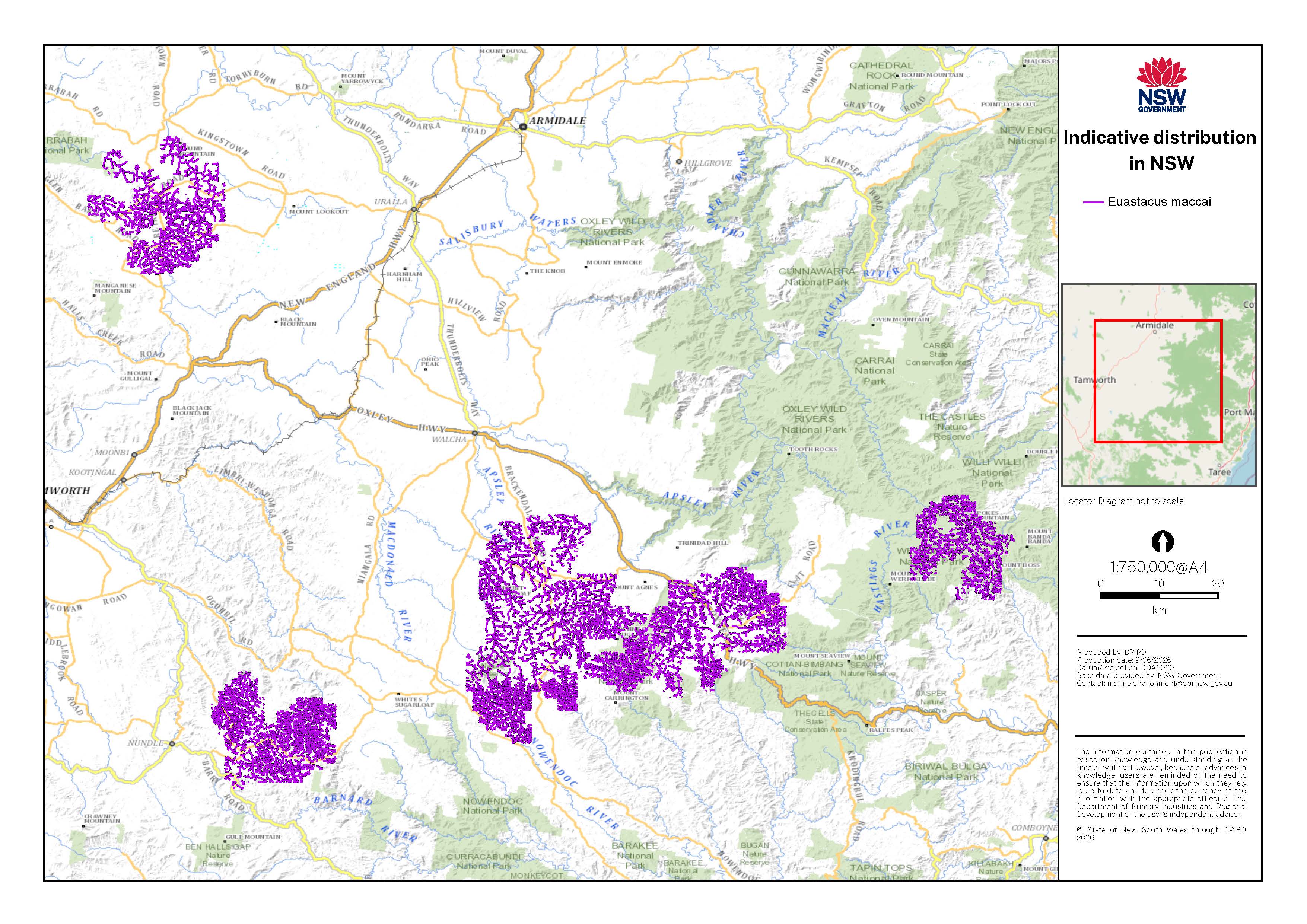
Distribution
The Terrestrial Crayfish is considered a short-range endemic species, restricted to upland areas between 850-1,400 m elevation. Parts of its range fall within protected areas including Werrikimbe National Park, Mummel Gulf National Park, Enfield, Riamukka and Nundle State Forests.
Habitat
The Terrestrial Crayfish inhabits terrestrial burrows that extend down to groundwater but do not connect to surface water. These burrows occur in:
- Ephemeral soaks
- Floodplains
- Spring‑fed swampy areas
- Cow paddocks and upland flats

Habitat of Terrestrial Crayfish habitat (R.McCormack).
Why is the Terrestrial Crayfish threatened?
The highly restricted distribution of this species puts all individuals in the population at considerable risk of extirpation by a single stochastic event, impacting the species across its very small range. The primary threats include:
- Increasing average environmental temperatures associated with climate change.
- Extreme weather events reduce groundwater availability, cause mortality, and alter soil moisture regimes essential for burrow stability
- Increase in frequency, severity and magnitude of bushfires
- Hydrological changes, such as altered rainfall patterns and lower groundwater tables reduce the availability of suitable burrowing habitat.
- Invasive species and disease.
- Illegal collection
- Livestock farming
