

Fish kills in NSW
Please report any fish death incidents or observations to the Fishers Watch Phoneline on 1800 043 536
What are fish kills?
Fish kills are defined as a sudden mass mortality of wild fish.
Fish kills can occur at any time although data indicates fish kills are more likely to occur in summer or following sudden changes in temperature.
Recent reports of fish kills are included in the table below and we will update the table as we receive reports.
Some of the key causes of fish kills are outlined in the information below.
Blackwater
Blackwater occurs naturally over time when leaf litter and woody debris build up on the floodplain and then get washed into the river system during a flood. It’s an important part of the aquatic food web as it provides food for insects which feed fish, frogs and other aquatic wildlife.
When there is a prolonged dry period, the leaf litter and organic matter on the floodplain builds up until the next flood event. This can result in a significant amount of organic matter returning to the river with any big flushes of water after prolonged drought, making blackwater events more likely.
Hypoxic blackwater
When there is a lot of organic material washed into the river, its rapid decay can consume dissolved oxygen from the water. If dissolved oxygen drops to very low levels, this can cause ‘hypoxic’ water which can be stressful for native fish and can lead to fish kills.
More information on blackwater can be found on the MDBA website , in this factsheet and on the department’s Water website under hypoxic water.
To notify the department of potential blackwater events email water.enquiries@dpie.nsw.gov.au or to report a fish kill, contact Fisheries on the Fishers Watch Phoneline on 1800 043 536.
Bushfire impacts on native fish
Find information on the impacts of bushfires on native fish.
Stratification?
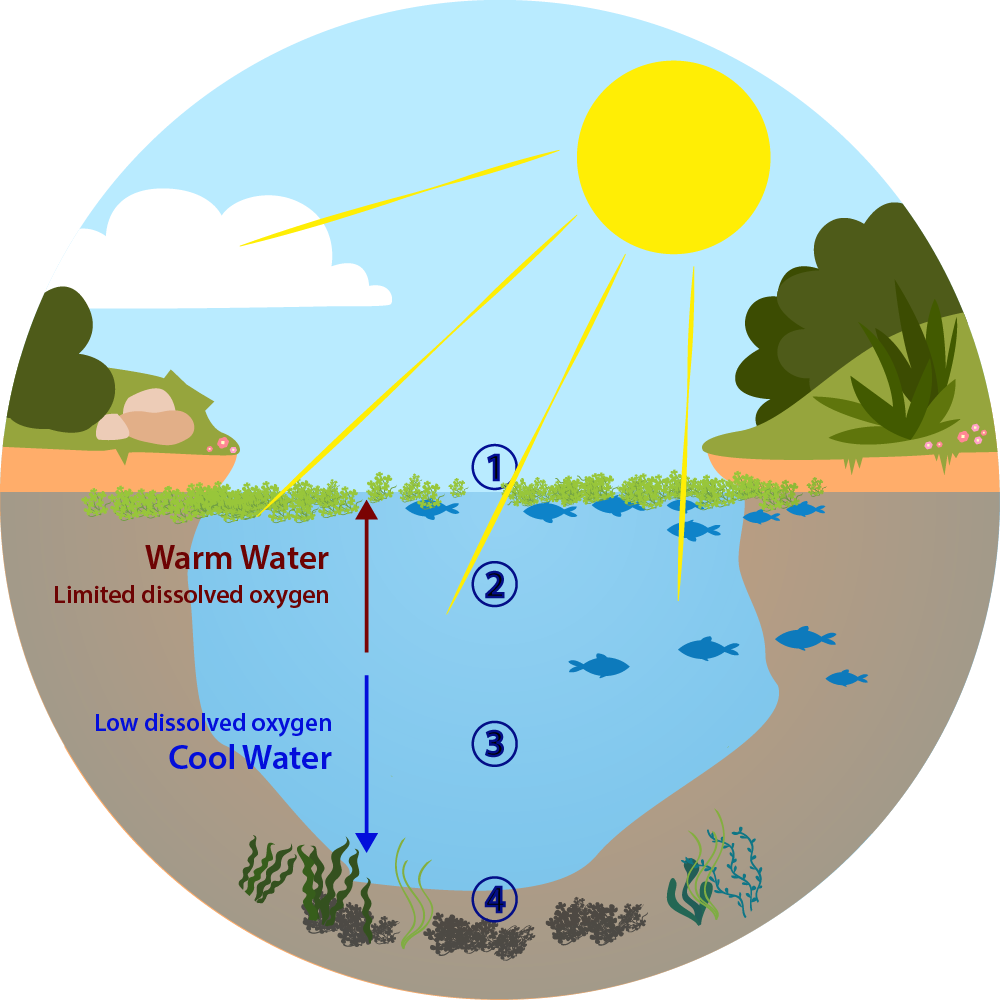
Stratification is when the surface of the water heats up more than the deeper water. That warmer layer tends to be warm and well-oxygenated compared to the deeper water that is colder and oxygen-depleted.
Thermal stratification
Key
- Blue Green Algal Bloom
Algal flourish in warm and still conditions, particularly in the absence of high flow - Surface Water Layer
Warm, high nutrient load from run off.
Dissolved oxygen by day, depletion overnight
Limited fish habitat - Deep Water Layer
Cooler, low light penetration, low dissolved oxygen (hypoxia), Poor fish habitat - Decomposition of organic matter
Depletes dissolved oxygen
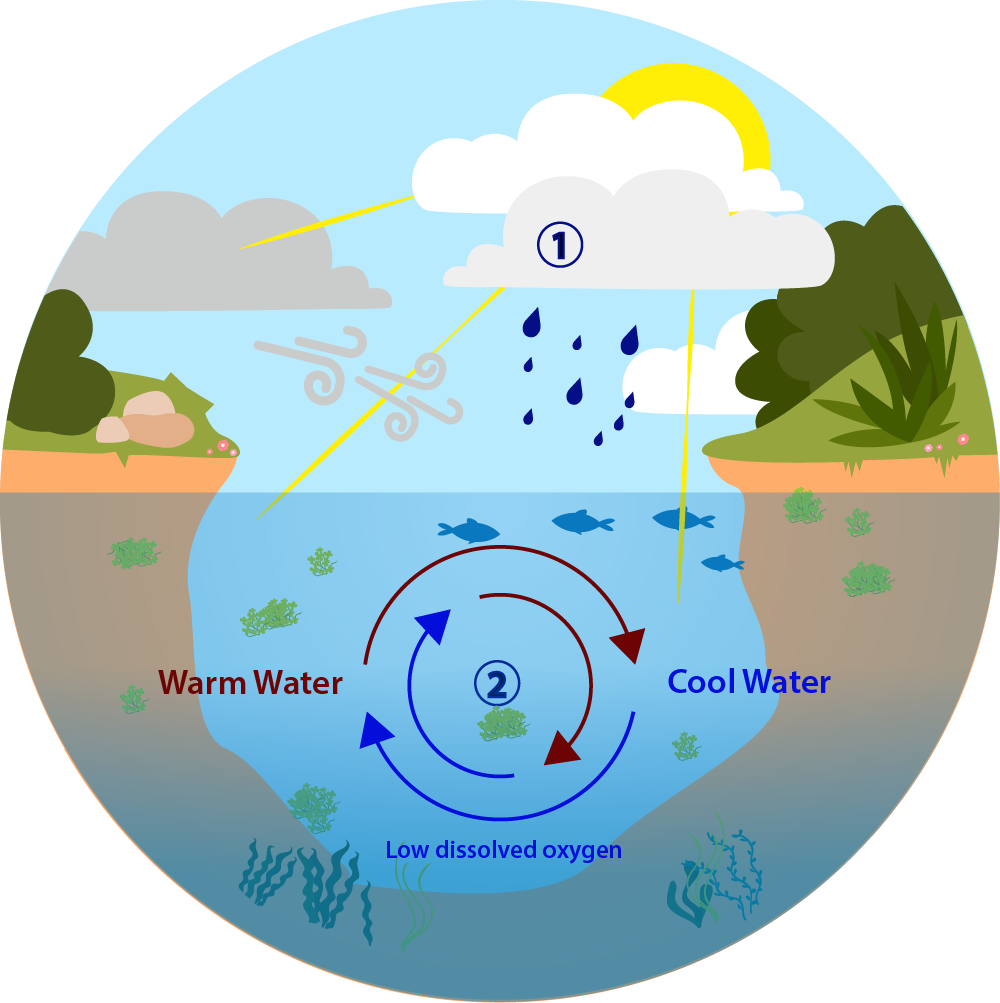
De-stratification ("Turn over")
Key
- Sudden weather events or small increases in flow
Can mix the warmer surface water and cooler deep water – essentially breaking down the temperature stratification - These changes can mix the warmer surface water with cooler deep water
Algal blooms may also be disrupted, potentially increasing decomposition (and further depleting oxygen). This means even at the surface dissolved oxygen levels can become critical, killing fish.
Simple things you can do
- Be on the lookout for any changes in water quality - i.e. changes to the colour or odour of your local waterway and report them to us via the Fishers Watch Phoneline on 1800 043 536.
- Contact us on the phoneline if you observe any dead fish or fish starting to gasp at the water surfaces.
Investigating and reporting
Vertessy Report Recommendations – Fish Deaths
2023 Fish deaths in the LDBR: summary of available Fisheries data
Lower Darling-Baaka Recovery Reach Fish Community Monitoring report (August 2023)
- The primary objective of the Lower Darling-Baaka Recovery Reach research was to evaluate the status of the fish community in the LDBR following the 2018 – 19 fish kills and track the trajectory of the fish community, including in Menindee Town Weir Pool and the LDBR downstream of Weir 32.
- Varied responses were observed in species abundances in the study reaches, attributed to the various life-history traits and reproductive strategies of native fish.
- The abundance of some native fish species in the LDBR has declined (in comparison to data collected since 2019) following the fish deaths events of early 2023.
- Murray Cod and Golden Perch abundance has declined in comparison to previous data collected since 2019.
- There were consecutive years of Murray Cod spawning in the LDBR between 2020-2021 on the back of water for the environment delivery.
- Carp were the most abundant species caught during the 2023 sampling.
- The results presented a fish community in continued stress. This is despite earlier demonstrated recovery of native fish from 2020-2022, driven by natural flows and deliveries of water for the environment to the LDBR.
- Sustained and holistic management actions are needed for native fish protection and recovery, with continued monitoring guiding and tracking the effectiveness of these actions in the region.
- With appropriate flow regimes, native fish communities will gradually recover, although catastrophic events such as fish kills related to lack of flow or hypoxic blackwater will hinder, and potentially undermine this recovery. Being long-lived, recovery of local populations of Murray Cod, Golden Perch and Silver Perch will take time.
Lower Darling-Baaka Recovery Reach Fish Community Monitoring report (August 2023)
Recent fish death events
Updated: 5 February 2026, 2:00pm
Below are the fish kills that were investigated and confirmed by NSW DPIRD Fisheries.
There is a current risk of widespread fish kills across parts of NSW. There may be other fish death events that have not been reported directly to NSW DPIRD Fisheries. To report fish deaths please contact 1800 043 536. This page will be updated as needed to maintain currency.
1 July 2025 - 30 June 2026
Location and date kill observed | Cause and extent |
|---|---|
Murray-Darling catchments in NSW | |
| Lake Menindee, Menindee (2 February) | Reports of a fish kill in Lake Menindee, with dead fish accumulating on the shore adjacent to the settlement of Sunset Strip. Numbers estimated to be in the hundreds of thousands and primarily affecting Bony Herring and Carp. No cause has been determined, but recent extreme temperatures, including heat and the recent cool change are likely to have had a greater influence on local water conditions in Lake Menindee as lake levels recede. Bony Herring are an important totemic native fish species for the Barkindji community and can breed in large numbers in suitable conditions but are susceptible to sudden changes in water and air temperature. Clean-up efforts are continuing by the Barkandji Prescribed Body Corporate (PBC) River Rangers with assistance from local and State government agencies. NSW Government agencies continue to monitor the situation closely. |
| Little Menindee Creek downstream to Weir 32 Lower Baaka River, Menindee (27 January – 1 February) | Report of a fish kill with numbers in the low hundreds estimated in the Lower Baaka River between Little Menindee Creek and Weir 32 near Menindee. The majority of fish recorded have been Carp with small numbers of native fish impacted including Bony Herring, Golden Perch and Silver Perch. The kill has been reported to have occurred at the downstream end of the town weir pool, focused on the section of river from where Little Menindee Creek meets the main weir pool down to Weir 32, as well as in Lake Menindee, and Little Menindee Creek itself including near the Lake Menindee Outlet Regulator. No cause has been determined, but the location of the fish kill does indicate that fish are predominantly dying in and near Lake Menindee where recent extreme temperatures (in the high 40s) are likely to be having a greater influence on local conditions. |
| Goulburn and Merriwa rivers (13 December) | Report of less than 50 dead fish mostly Carp after the bushfire in the catchment. Suspected cause is attributed to a drop in Dissolved Oxygen (DO) from ash and sediment being washed into the river after a bushfire. |
| Lake Brewster, Lake Cargelligo (27 November) | Report of hundreds of dead fish including Carp, Golden Perch and Murray Cod. Suspected cause is low Dissolved Oxygen (DO). |
| Namoi River, below Keepit Dam (10 November) | Report of less than 30 dead fish including Murray Cod, Bony Herring and Carp. Cause has been attributed to fluctuating river heights and temperatures associated with a drop in Dissolved Oxygen (DO) for native fish. |
| Lachlan River, between Booberoi and Cargelligo Weirs (30 August) | Report of 20 dead Murray Cod, cause unknown. |
| Chinamans Dam, Lachlan River (8 August) | Report of less than 50 dead Freshwater Catfish reported. Cause unknown. |
| Lake Cargelligo, Lachlan (6 July) | Report of thousands of dead Bony Herring reported at Lake Cargelligo. DPIRD Fisheries staff attended the site on 8 July 2025 in line with the fish kill protocol. Bony Herring can become stressed or die when water temperatures drop – this is known as ‘winter die off’. DPIRD Fisheries staff have confirmed that this is the suspected cause of this fish kill event. |
Coastal catchments in NSW | |
| Bolwarra Lagoon (8 January) | Report of hundreds of dead Carp. Cause has been attributed to a drop in Dissolved Oxygen (DO) in the lagoon with very low water levels after hot days. |
| Ironbark Creek Bridge, Hunter River (12 December) | Report of thousands of dead fish including Bream, Dusky Flathead and Mullet. Cause unknown but there were very high temperatures in the days prior. NSW EPA are the lead agency for fish kills in the Sydney Metro, including Newcastle area. |
| Redhead Beach, Redhead (13 November) | Report of less than 50 dead fish at Redhead Beach affecting Porcupinefish. Cause unknown. |
| Maggies Beach, Cabarita (29 October) | Report of less than 50 dead fish including Yellowfin Leatherjacket, Yellow Boxfish and Pufferfish. The suspected cause is attributed to cold stress caused by lower temperatures. |
| Myall Lakes, Mid North Coast (14 July) | Report of thousands of dead fish in the Myall Lakes system, near Mungo Brush. Species affected were Bream, Whiting, Luderick, Flathead, Mulloway, Eels and Prawns. Results from the investigation into the fish kill identified the majority of the fish samples were infected with the fungus Saprolegnia sp (or Winter Disease) which is commonly associated with prolonged exposure to cold temperatures and low salinity, conditions which had been observed within the lake system due to recent heavy rains. Samples also exhibited internal infection with Aeromonas sp bacteria and signs of proliferative branchitis (lesions) within their gills. These were likely secondary infections. |
| Morton’s Creek, Bellangry, Wauchope (2 July) | Report of less than 10 dead Australian Bass. Specific cause unknown however, most likely attributed to de-oxygenation from vegetation accumulation within the waterway. |
