Why be involved?
By participating in the LEIFS initiative, you will:
- Demonstrate evidence-based strategies that lower emissions on your farm.
- Receive an estimate of the emissions intensity (emissions per tonne of grain or cotton) of crops grown on your demonstration site, which will be calculated with and without greenhouse gas emissions reduction strategies implemented.
- Receive a payment of $5,000 for each eligible strategy implemented per cropping season, for providing NSW DPIRD with access to your demonstration site data. NSW DPIRD will use the data to calculate the emissions intensity of crops grown on your demonstration site.
- Provide feedback on your experience of implementing the strategies. This feedback will be used to better understand the pros and cons of implementing emissions reduction strategies in grain and cotton production systems.
- Gain insight into the technology that NSW DPIRD will develop to streamline the process to calculate emissions and, if desired, transfer emissions data to the supply chain.
- Have the opportunity to share your knowledge and learn from other growers by participating in group discussions and field day events (with the option to host a field day at your farm).
Demonstration strategies
You can demonstrate one or more of the emissions reduction strategies listed below:
- Enhanced efficiency fertilisers with nitrification inhibitors: using nitrification inhibitor coated urea at sowing/planting.
- Enhanced efficiency fertilisers with urease inhibitors: spreading urease inhibitor coated urea at sowing or in-crop.
- Variable rate nitrogen (N): varying N rates for areas with different yield potential to minimise overapplication of N.
- N banking: reserving N in the soil for crop use over multiple seasons.
- Matched N: N supply is matched to yield target.
- In-crop monitoring to refine N budget: monitoring soil moisture for more accurate estimates of yield potential to refine in-crop N applications.
- Increased legume frequency: introducing, or increasing the frequency of, legumes in a rotation to reduce N fertiliser inputs.
- Green N: using low emissions N fertiliser.
- Renewable diesel: replacing fossil diesel with renewable diesel or a blend containing renewable diesel.
- Biodiesel: replacing fossil diesel with a blend containing biodiesel.
- Electric pumping: replacing a diesel pump with an electric pump or replacing a diesel generator powering an electric pump with a lower emissions source of electricity.
Crops
Demonstrations of emissions reduction strategies for the following crops are within the scope of the program:
- Cotton
- Wheat
- Coarse grains — barley, oats, sorghum, maize, triticale, millets/panicums, cereal rye and canary seed
- Pulses — black gram, lupins, field peas, chickpeas, faba beans, vetch, peanuts, mungbeans, navy beans, pigeon peas, soybeans, cowpeas, wild cowpeas and lentils
- Oilseeds — canola, sunflower, safflower and linseed.
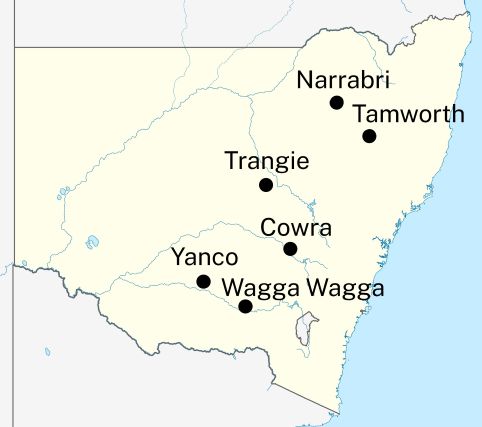
Regions where LEIFS will operate in NSW
Details
For more details about participating in the LEIFS initiative, please see the Expressions of Interest document.
For the variable rate N, matched N, N banking and in-crop monitoring strategies, please also see the Soil testing protocol.
Enquiries
Email: leifs@dpird.nsw.gov.au
Register your interest
The Low Emissions Intensity Farming Systems (LEIFS) initiative is a greenhouse gas (GHG) emissions reduction research, development and extension project, developed by the Grains Research and Development Corporation (GRDC) and delivered by NSW DPIRD, WA DPIRD, SARDI and CSIRO. In collaboration with GRDC, Cotton Research and Development Corporation (CRDC) has adapted this project for the cotton industry via the Cotton LEIFS project delivered by NSW DPIRD and Qld DPI.