

Capturing nutrients at the CCC Blueberry Research Facility
How dolomite phosphorus filters, bioreactors, and reedbeds are being used to capture excess phosphorus, nitrate (NO3-) and ammonium (NH4+) in crop runoff water
Authors: Dr Mark Bayley (Mark Bayley Consulting), Melinda Simpson and Diana Unsworth (NSW DPIRD). Edited by Meg Strang (NSW DPIRD).
Published 12 September 2025
Dolomite based phosphorus filters have been added to nutrient management systems at the Clean Coastal Catchments (CCC) Blueberry Research Facility on the NSW North Coast.
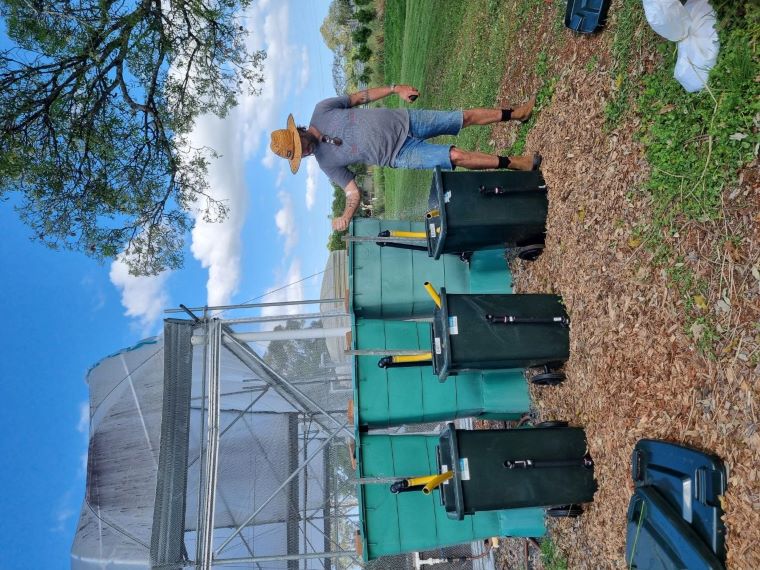
The CCC Research team is investigating the effectiveness of dolomite as a filter for capturing excess phosphorus from blueberry crop runoff water at the Wollongbar Primary Industries Institute.
The filters were installed in October 2024 to reduce the concentration of phosphorus in the runoff flowing from 300 potted blueberry plants at the site.
The aim of this research is to come up with an enhanced and cost-effective filtration system that will enable blueberry growers to capture excess phosphorus in irrigation waste water before it escapes into the broader environment.
Key to this research is the identification of a suitable filter medium, such as dolomite, that is affordable and easily accessible to growers.
Bioreactors and reedbed installed in 2023 to remove nitrates
Environmental Scientist, Dr Mark Bayley, has been engaged by the CCC Research project to lead CCC’s research on nature based strategies (such as bioreactors and artificial wetlands). These strategies have been implemented to manage excess nutrients in the irrigation drainage from our potted blueberry crop.
Back in 2023, Dr Bayley coordinated the installation of a reedbed and three woodchip based denitrification bioreactors (housed in large plastic bins) at the CCC Blueberry Research Facility at Wollongbar. The reedbed and the bioreactors treat the excess nitrate flowing off the potted blueberries, turning potentially toxic nitrate (NO3-) into harmless molecular nitrogen gas (N2).
N2 is the most abundant gas in the earth’s atmosphere, making up to 78% of the air we breathe. However, nitrogen in the form of NO3- dissolved in water can cause toxic algal blooms in creeks, rivers, and estuaries.
Bioreactors remove more than 95% of nitrates and up to 83% of ammonium
Blueberry runoff also contains relatively high concentrations of ammonium (NH4+) as ammonium based nitrogen fertilisers are commonly used in blueberry production. Ammonium can convert readily into toxic NO3- in the environment.
At elevated concentrations, some forms of nitrogen can result in 'indirect' toxic effects on aquatic life. These indirect effects can include eutrophication and hypoxia caused by algal blooms that deplete oxygen in water bodies such as lakes and rivers. Ammonium is a form of nitrogen that can also cause 'direct' toxic effects on aquatic life such as death and reduced growth rates (Australian Government Department of Climate Change, Energy, the Environment and Water) *1.
Monitoring at the Wollongbar site has shown that under the right conditions, woodchip bioreactors can remove more than 95% of nitrates and up to 83% of ammonium in the research facility runoff water.
According to Dr Bayley, the high rates of ammonium loss could be a result of anaerobic ammonia oxidation (Anammox) occurring within the bioreactor. This possibility will be further investigated by the CCC team in future research.
Lower rates of nitrate and ammonium reduction in Wollongbar reedbed
In contrast to the results achieved in the bioreactors, nitrate reduction rates in the reedbed were much lower, ranging from 4% - 80%, with a median rate of 20%. Ammonium reduction in the reed bed ranged from 17% to 83%, with a median rate of 50%, with increased removal occurring at lower flow rates.
The CCC research team aims to improve nitrogen removal efficiency in both the bioreactor and wetland treatments at the Wollongbar site, by finding the optimal sizing and flow rate for each system.
High concentrations of phosphorus in blueberry crop runoff

Like nitrogen, excess phosphorus fertiliser flowing off crops can also end up as nutrient pollution in the wider coastal ecosystem. Measurements taken in late 2024 and early 2025, showed the irrigation runoff at the CCC Blueberry Research Facility contained a consistently high concentration of phosphorus (34- 60 milligrams per litre).
The reedbed at the Wollongbar site has achieved reasonable reductions in phosphorus concentrations in waste water, with the reduction ranging from 15% to 68% (median rate: 31%).
Previous research suggests that the reedbed is unlikely to keep removing phosphorus effectively over the long term (Davison, Headley and Pratt 2004) *2, as phosphorus is removed by the reedbed system primarily through adsorption.
Adsorption is the process in which molecules adhere to the surface of liquids or solids. In the adsorption process, the phosphorus atoms, ions or molecules, create a film that adheres to the gravel at the bottom of the reedbed.
Initially, large amounts of phosphorus can be captured as it sticks to the surface of the gravel in the reedbed. However, over time the gravel becomes fully saturated with phosphorus, restricting the capacity for ongoing removal.
New filters installed in 2025 to remove phosphorus
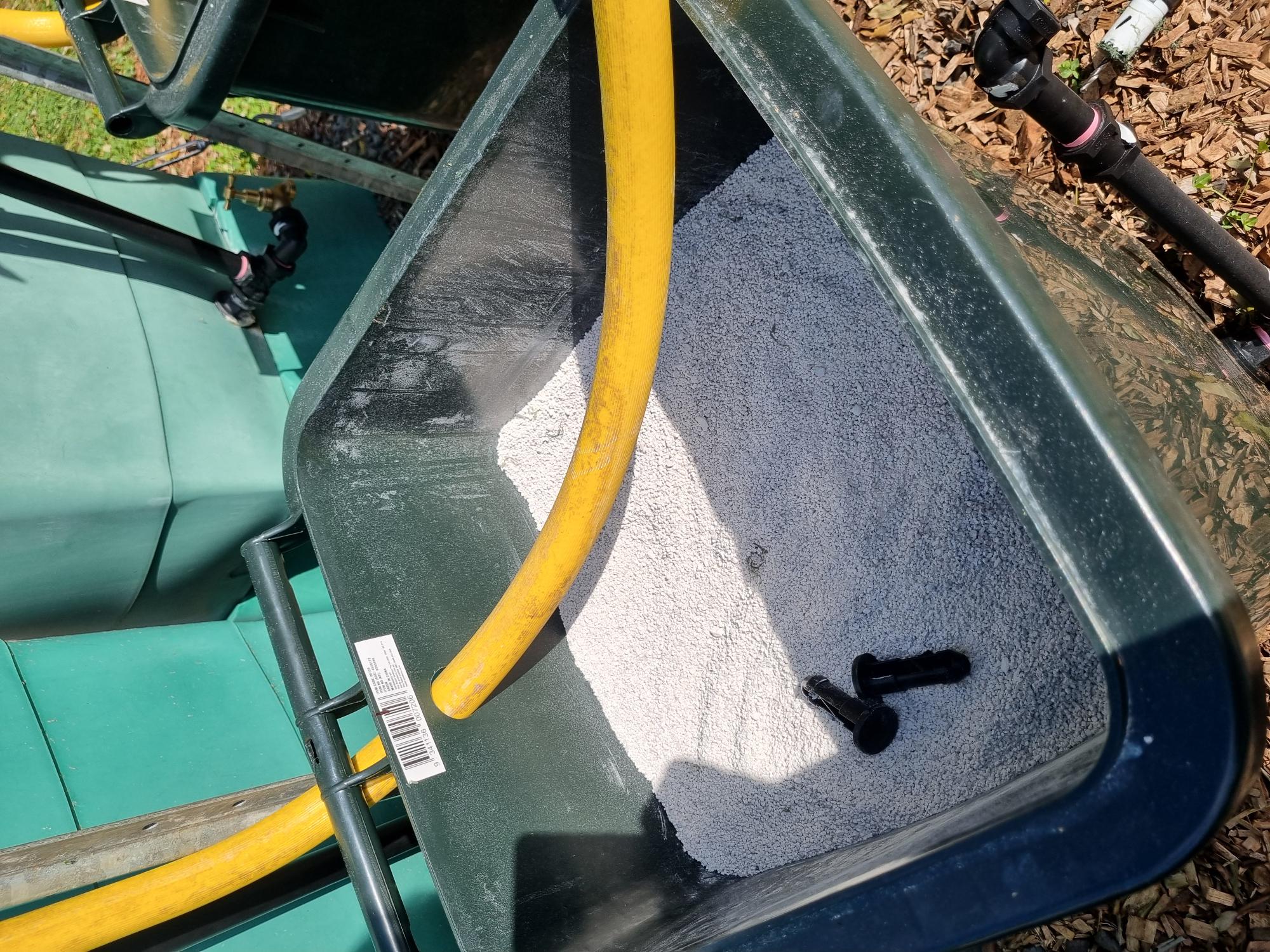
In early 2025, Dr Bayley installed dolomite based (2-3mm coarse chips) phosphorus filters next to each of the three denitrification (nitrate removing) bioreactor units at the end of the Wollongbar blueberry tunnel.
After the crop runoff water flows through the bioreactor units, the water flows via a connecting pipe into the top of the adjoining phosphorus filters. The water then soaks down through the dolomite which captures a large proportion of the phosphorus.
The installation of the dolomite filters has significantly improved phosphorus capture in the waste water at Wollongbar. Very little phosphorus at the site had previously been captured by the woodchip bioreactors, while it took more than a year for the reedbed system at Wollongbar to achieve consistent phosphorus removal rates. In contrast, the newly installed dolomite based filters were able to reliably capture consistent rates of phosphorus from the first day of operation.
Dolomite filter achieves 41% removal of phosphorus concentration at Wollongbar
“The challenge with phosphorus removal has been to find a suitable media that could be cheaply and easily obtained by farmers,” said Dr Bayley.
“While there are many great commercially available materials that can achieve high rates of phosphorus removal, most of these are expensive and difficult to obtain. Dolomite, however, is a common and relatively cheap substance."
Early results from the dolomite filter trial (up to April 2025) showed that running the crop waste water through the phosphorus filter bins, resulted in an average reduction of 41% (ranging from 25% to 56%) in phosphate concentrations.
This was a significant improvement on the phosphate removal achieved through the woodchip bioreactors. The bioreactors removed very little phosphate from the crop waste water, with results ranging from zero up to a maximum 10% reduction in the phosphorus concentration, and a median reduction rate of just 6%.
Final results from the CCC phosphorus filter trials are expected to be released in early 2026.
Hort 360 progresses CCC bioreactor research
Building on earlier CCC research, a full scale nitrogen bioreactor and phosphorus filter system has been installed at a berry farm at Corindi on the NSW north coast.
The system will treat irrigation runoff from 4000 raspberry plants, with the aim of removing more than 80% of all nitrates in waste water from this site.
The system is part of a research site established by Berries Australia and the Department of Primary Industries and Regional Development (DPIRD) through the NSW Government’s Storm and Flood Industry Recovery Program.
Cost benefit analysis
Full construction costs will be carefully tracked at the Corindi site. Once the treatment performance of the system is established, a scalable cost benefit assessment will be completed.
DPIRD Blueberry Development Officer, Melinda Simpson, says the results of this trial could potentially be used to justify investment in bioreactor and phosphorus filter technology, and to support the protection of the downstream environment.
Bioreactor and wetland challenges.

There are still hurdles to overcome regarding the use of both bioreactors and wetlands in intensive horticulture.
“Bioreactors are fantastic at removing nitrate and to a lesser extent ammonium, however their effectiveness rapidly declines if you don’t get the conditions right,” explained Melinda Simpson.
“Constructed wetlands are useful for ammonia removal, however for wetland technology to be worthwhile, large areas of land are required for wetland construction,” said Ms Simpson.
“That can make wetland technology difficult to implement successfully in highly intensive horticulture operations on small acreages, such as protected cropping blueberry farms.”
Ideally, as Ms Simpson points out, the best way to reduce the build-up of excess nutrient concentrations in our rivers and creeks, is to reduce the amount of fertiliser nutrients being used on farms upstream.
“Bioreactors and wetlands are great mops, but it’s always better not to have to mop the floor!”
Best results likely from integrated nutrient management
An integrated approach to nutrient management is likely to achieve the best results, focused on applying the right amount of fertiliser on crops (with as little excess as possible), in conjunction with nature based nutrient management solutions, such as bioreactors and wetlands, to reduce the concentration of waste nutrients that will inevitably accumulate in crop runoff.
The DPIRD CCC project is investigating a range of technologies and farm management practices to improve nutrient use efficiency in berry production, while also preventing nutrients that remain in waste water from flowing off the farm.
The CCC project is delivered through the NSW Department of Primary Industries and Regional Development and is funded by the NSW Government under the Marine Estate Management Strategy (MEMS). The ten-year strategy was developed by the NSW Marine Estate Management Authority to coordinate the management of the marine estate.
References
*1. Australian Government Department of Climate Change, Energy, the Environment and Water - National Pollutant Inventory online fact sheet: Ammonia - Environmental Effects. Website accessed September 2025: https://www.dcceew.gov.au/environment/protection/npi/substances/fact-sheets/ammonia-total#tabs-3
*2. Davison, Headley and Pratt 2004 ‘Secondary treatment by reed bed – eight years experience in north eastern New South Wales’ authored by Leigh Davison, Tom Headley and Katie Pratt from the Centre for Ecotechnology, Southern Cross University, Lismore, 2480. Presented at International On-site Wastewater Treatment & Recycling Conference, Freemantle, 12-14 Feb 2004: https://wetsystems.com.au/wp-content/uploads/2019/05/Davison-Headley-Pratt-Freemantle-conference-2004.pdf
