

Woolly pod vetch
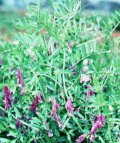
Woolly pod vetch
(High-resolution
image available)
NOTE: The information in this Agnote must be read in conjunction with Introduction to selecting and using pastures in NSW, which covers information on areas of adaptation, sources of variability, species mixtures, and important issues related to animal health and the conservation of native vegetation.
| Pasture type and use | Annual legume, producing most of its growth in autumn, winter and spring. Grazing, hay. |
|---|---|
| Area of adaptation | Southern to Northern Tablelands, Central to North West Slopes. |
| Min. average annual rainfall | 550 mm (southern NSW) to 650 mm (northern NSW). |
| Advantages |
|
| Disadvantages |
|
| Soil requirements | Adapted to a wide range of soils from granite to heavy basalt. Suited to well-drained soils with low levels of exchangeable aluminium. |
| Varieties | Select varieties on the basis of hard-seed levels.
* Denotes that this variety is protected by Plant Breeder’s Rights. |
| Sowing rates: | |
| - as only species | 6–10 kg/ha |
| - in mixtures | 4–6 kg/ha |
| Sowing time | Autumn |
| Companion species | Cereal fodder crops, perennial grasses. |
| Inoculation | Group E |
| Major nutrient deficiencies | Phosphorus, sulfur, molybdenum. |
| Main insect pests | Heliothis, lucerne seed web moth. |
| Main diseases | Botrytis grey mould. |
| Management | Do not graze young seedlings before branching occurs. Avoid grazing from flowering onwards in the first year, and when attempting to build up a seed reserve in soil. |
| Livestock disorders of particular note | ‘Ill thrift’ syndrome in cattle, with dermatitis and diarrhoea (sometimes). |
| Additional tips |
|
| Further information | Agfact P2.5.9 Namoi woolly pod vetch. |
Acknowledgments
Advice on livestock health disorders was provided by Dr Chris Bourke, Principal Research Scientist, NSW Agriculture, Orange. His contribution is gratefully acknowledged.
Photo: Warren McDonald, Former Technical Specialist (Pastures), NSW Agriculture, Tamworth
