

White clover
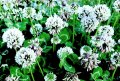
White clover
(High-resolution
image available)
NOTE: The information in this Agnote must be read in conjunction with Introduction to selecting and using pastures in NSW, which covers information on areas of adaptation, sources of variability, species mixtures, and important issues related to animal health and the conservation of native vegetation.
| Pasture type and use | Perennial pasture legume with main growth in spring / summer / autumn. Irrigated or dryland. Grazing, pasture hay, ground cover for horticulture. |
|---|---|
| Area of adaptation | Coast, tablelands and slopes. Irrigated areas central and south inland. |
| Min. average annual rainfall | 750 mm with summer incidence. |
| Advantages |
|
| Disadvantages |
|
| Soil requirements | Grows on a wide range of soil types provided fertility (phosphorus and sulfur) is medium to high, and soil has good water-holding capacity (drier areas). Medium to well drained. Tolerant of soil acidity where pH(Ca) > 4.5. Soil aluminium less than 20% of CEC. In marginal environments, prefers slopes with southerly aspect. |
| Varieties | Select on the basis of plant habit and seasonal production.
* Denotes that this variety is protected by Plant Breeder’s Rights.
* Denotes that this variety is protected by Plant Breeder’s Rights. |
| Sowing rates: | |
| - as only species | 4.0–5.0 kg high-density winter forage (coast). |
| - in mixtures | 0.5–3.0 kg/ha |
| Sowing time | Autumn, early winter: Dryland (all districts). Spring: Irrigation and higher-rainfall tableland districts. |
| Companion species | Compatible with many temperate and subtropical grasses.
In temperate and tableland areas: perennial ryegrass, phalaris, cocksfoot and tall fescue.
On the South Coast and western irrigated areas: perennial ryegrass and Italian ryegrass, paspalum and kikuyu. Central and North Coast: kikuyu, paspalum, setaria, Rhodes grass, perennial ryegrass and Italian ryegrass. |
| Inoculation | Group B |
| Major nutrient deficiencies | Phosphorus, sulfur, molybdenum, potassium. |
| Main insect pests | Redlegged earth mite, blue oat mite, bluegreen aphid, cutworms. |
| Main diseases | Rugose leaf curl, mosaic, rust, root rot caused by several fungal pathogens.
Nematodes: Root knot nematode (North Coast). |
| Management | Can tolerate close grazing. Management should aim to maintain a 70% grass 30% clover balance. Pasture should be kept less than 15 cm in height to allow light to penetrate for clover. Vigorous grass growth may outcompete clover. |
| Livestock disorders of particular note | Bloat in cattle; urinary calculi (clover stones) incidence may increase in sheep; occasionally red gut in sheep. |
| Additional tips | When topdressing fertiliser (phosphorus and sulfur), add low rates of seed. Avoid close grazing in dry summer conditions. |
| Further information |
|
Acknowledgments
Advice on livestock health disorders was provided by Dr Chris Bourke, Principal Research Scientist, NSW Agriculture, Orange. His contribution is gratefully acknowledged.
Photo: Mary-Anne Lattimore, NSW Agriculture, Yanco
