

Snail medic
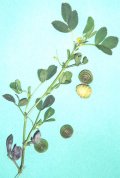
Snail medic
(High-resolution
image available)
NOTE: The information in this Agnote must be read in conjunction with Introduction to selecting and using pastures in NSW, which covers information on areas of adaptation, sources of variability, species mixtures, and important issues related to animal health and the conservation of native vegetation.
| Pasture type and use | Winter/spring growing annual legume. Dryland grazing and crop rotation. |
|---|---|
| Area of adaptation | Mainly in the North West and Central West Slopes and Plains. |
| Min. average annual rainfall | 400 mm (southern NSW) to 500 mm (northern NSW) |
| Advantages |
|
| Disadvantages |
|
| Soil requirements | Prefers neutral–alkaline and heavier soils. Better regeneration on self-mulching soils. Will not tolerate exchangeable soil aluminium >10%. |
| Varieties | Select varieties on the basis of maturity, yield and persistence.
|
| Sowing rates: | |
| - as only species | 4–7 kg/ha |
| - in mixtures | 3 kg/ha |
| Sowing time | Autumn for all districts. |
| Companion species | Lucerne (winter-active) in appropriate soil types. |
| Inoculation | Medic (or group AM). |
| Major nutrient deficiencies | Usually phosphorus, sulfur in some areas, occasionally zinc and molybdenum. |
| Main insect pests | Redlegged earth mite, blue oat mite, lucerne flea, spotted alfalfa aphid, bluegreen aphid, pea aphid. |
| Main diseases | Root rot, alfalfa mosaic virus, phoma. |
| Management | Once established can be continuously grazed. Avoid overgrazing at seed-set in initial year to build seed reserves. |
| Livestock disorders of particular note | Photosensitisation in horses; occasionally red gut in sheep; frequently bloat in cattle. |
| Additional tips |
|
| Further information |
|
Acknowledgments
Advice on livestock health disorders was provided by Dr Chris Bourke, Principal Research Scientist, NSW Agriculture, Orange. His contribution is gratefully acknowledged.
Photo: Mary-Anne Lattimore, NSW Agriculture, Yanco.
