

Slender serradella Ornithopus pinnatus
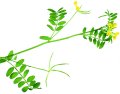
Slender serradella
(High-resolution
image available)
NOTE: The information in this Agnote must be read in conjunction with Introduction to selecting and using pastures in NSW, which covers information on areas of adaptation, sources of variability, species mixtures, and important issues related to animal health and the conservation of native vegetation.
| Pasture type and use | Annual legume with main growth in winter and especially spring. Mainly used as a pasture plant, and suited for grazing, hay or silage. Particularly tolerant of acid soils. It has good tolerance to waterlogged conditions. |
|---|---|
| Area of adaptation | North West Slopes, Central West Slopes, Northern Tablelands, Central Tablelands, Southern Tablelands. It may suit some coastal areas. |
| Min. average annual rainfall | 400 mm (southern NSW) to 450 mm (northern NSW). |
| Advantages |
|
| Disadvantages |
|
| Soil requirements | Does well on shallow (40–80 cm), poorly drained, lighter to medium loam soils. Tolerant of soil aluminium up to 30% of CEC. Tolerant of low pH (Ca) up to 4.0–7.0. Suited to hard-setting (e.g. sodic) but waterlogged-prone soils. Adequate phosphorus, sulfur and molybdenum required. |
| Varieties | Jebala (mid-season maturity) McFarlanes |
| Sowing rate | 1–3 kg/ha. Often sown with other legumes (e.g. yellow serradella and sub clover) because of soil type variability over a paddock. Seed is very small. |
| Sowing time | Autumn — late March through to early June. |
| Companion species | Other winter legumes (yellow serradella, sub clover, arrowleaf clover, Persian clover, balansa clover) on variable soil paddocks, and a summer-growing perennial grass species. |
| Inoculation | Group G. Lime pelleting is desirable. |
| Major nutrient deficiencies | Phosphorus, sulfur, molybdenum. |
| Main insect pests | Blue oat mite (some tolerance), redlegged earth mite (some tolerance), lucerne flea, vegetable weevil, jassids, Heliothis punctigera (native bud worm). |
| Main diseases | Very few disease problems yet observed. Potential diseases include brown leaf spot (Pleiochaeta setosa), grey mould (Botrytis cinerea), anthracnose, and cercospora fungus. |
| Management | Suited to moderate set stocking as well as rotational grazing. Can be damaged if heavily grazed following a long period of regrowth resulting in rank growth. It is important to graze down dry summer material by early autumn to around 1–1.5 t/ha dry matter to encourage good autumn germination. Do not graze too hard during flowering, especially until seed reserves are adequate. |
| Livestock disorders of particular note | No problems reported. |
| Additional tips | Sowing seed shallow and controlling weeds will generally ensure faster establishment. |
| Further information |
|
Acknowledgments
Advice on livestock health disorders was provided by Dr Chris Bourke, Principal Research Scientist, NSW Agriculture, Orange. His contribution is gratefully acknowledged.
Photo: M. Davies, Department of Agriculture, Western Australia.
