

Rose clover
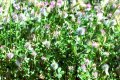
Rose clover
(High-resolution
image available)
NOTE: The information in this Agnote must be read in conjunction with Introduction to selecting and using pastures in NSW, which covers information on areas of adaptation, sources of variability, species mixtures, and important issues related to animal health and the conservation of native vegetation.
| Pasture type and use | Annual winter/spring growing legume. Suited to grazing - especially cattle. Useful as a pioneer plant in reclamation work. Tolerates mildly acid soil. |
|---|---|
| Area of adaptation | Central West Slopes, North West Slopes, Central West Plains. |
| Min. average annual rainfall | 400 mm (southern NSW) to 650 mm (northern NSW). |
| Advantages |
|
| Disadvantages |
|
| Soil requirements | Widely adapted, including mildly acid red gradational and duplex soils, light granitic and sedimentary derived soils. |
| Varieties | Hykon |
| Sowing rate - in mixtures | 0.5–1.0 kg/ha in a 4–5 kg/ha mix. |
| Sowing time | Autumn |
| Companion species | Sub clover, barrel medic, lucerne, perennial grasses depending on district and soil type. |
| Inoculation | Group C |
| Major nutrient deficiencies | Phosphorus, sulfur, molybdenum. |
| Main insect pests | No major problems encountered. |
| Main diseases | No major problems encountered. |
| Management | Avoid heavy grazing in spring if soil seed reserves are low. Spelling following germination will enhance density. |
| Livestock disorders of particular note | The ingestion of old flower heads may be associated with fibre ball (phytobezoar) development in the abomasum of cattle, and with wool contamination in sheep. Bloat in cattle; urinary calculi (clover stones) incidence may increase in sheep; occasionally red gut in sheep. |
| Additional tips | Avoid grazing lambs on mature rose clover pastures if crutching or shearing in February/March. |
Acknowledgments
Advice on livestock health disorders was provided by Dr Chris Bourke, Principal Research Scientist, NSW Agriculture, Orange. His contribution is gratefully acknowledged.
Photo: Mary-Anne Lattimore, NSW Agriculture, Yanco.
