

Kenya Clover
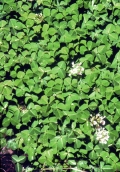
Kenya Clover
(High-resolution
image available)
NOTE: The information in this Agnote must be read in conjunction with Introduction to selecting and using pastures in NSW, which covers information on areas of adaptation, sources of variability, species mixtures, and important issues related to animal health and the conservation of native vegetation.
| Pasture type and use | Perennial pasture legume with main growth in spring/summer and autumn. Grazing. |
| Area of adaptation | North Coast |
| Min. average annual rainfall | 1000 mm |
| Advantages |
|
| Disadvantages |
|
| Soil requirements | Well-drained soils of medium to high fertility. High tolerance to acid soils. |
| Varieties | Safari. (Seed scarce or unobtainable in commercial quantities.) |
| Sowing rate | 2–4 kg/ha |
| Sowing time | Autumn |
| Companion species | Compatible with any tropical grass that can tolerate heavy grazing, e.g. kikuyu, paspalum, rhodes grass. |
| Inoculation | Group K. Inoculation is essential. |
| Major nutrient deficiencies | Phosphorus, sulfur, molybdenum, potassium. |
| Main insect pests | Amnemus weevil, whitefringed weevil, slugs. |
| Main diseases | Rugose leaf curl (in newly sown pastures). |
| Management | Light grazing in first year to allow flowering and seed-set to build soil seed reserves. Once established, heavy grazing in summer to prevent a grass overburden and to keep stolons close to the ground. Undergrazing reduces persistence. |
| Livestock disorders of particular note | Bloat in cattle. |
| Additional tips |
|
| Further information | Agfact P2.5.18 Safari kenya white clover. |
Acknowledgments
Advice on livestock health disorders was provided by Dr Chris Bourke, Principal Research Scientist, NSW Agriculture, Orange. His contribution is gratefully acknowledged.
Photo: Warren McDonald, Former Technical Specialist (Pastures), NSW Agriculture, Tamworth
