

Pasture dieback
Reviewed: January 2026
 Read the Pasture Dieback Identification Guide
About pasture dieback
Pasture dieback is a condition that kills sown and native summer growing grass pastures. It starts as small patches and can spread to affect large areas. The grasses die reducing feed available for livestock. Often groundcover in these areas is low allowing broadleaf weeds to colonise. Pasture dieback is not limited by landscape or soil type. Livestock avoid grazing affected areas (Figure 1).
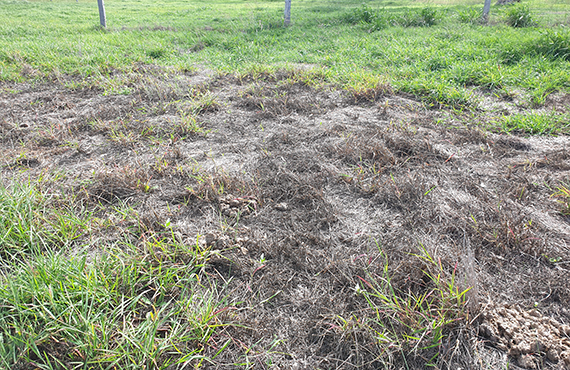
The current outbreak in Queensland commenced summer 2014-15. It has now spread across Queensland in coastal and inland regions from the far north, west to Mount Isa and south into New South Wales (NSW). Pasture dieback was confirmed on the NSW North Coast in autumn 2020. It has since spread to inland NSW near Warialda and Tamworth, and south to the Hunter Valley (Figure 2).

What to look for
Symptoms are most evident when grasses are actively growing during spring, summer and autumn, especially following significant rainfall. The stages of symptom progression of pasture dieback include:
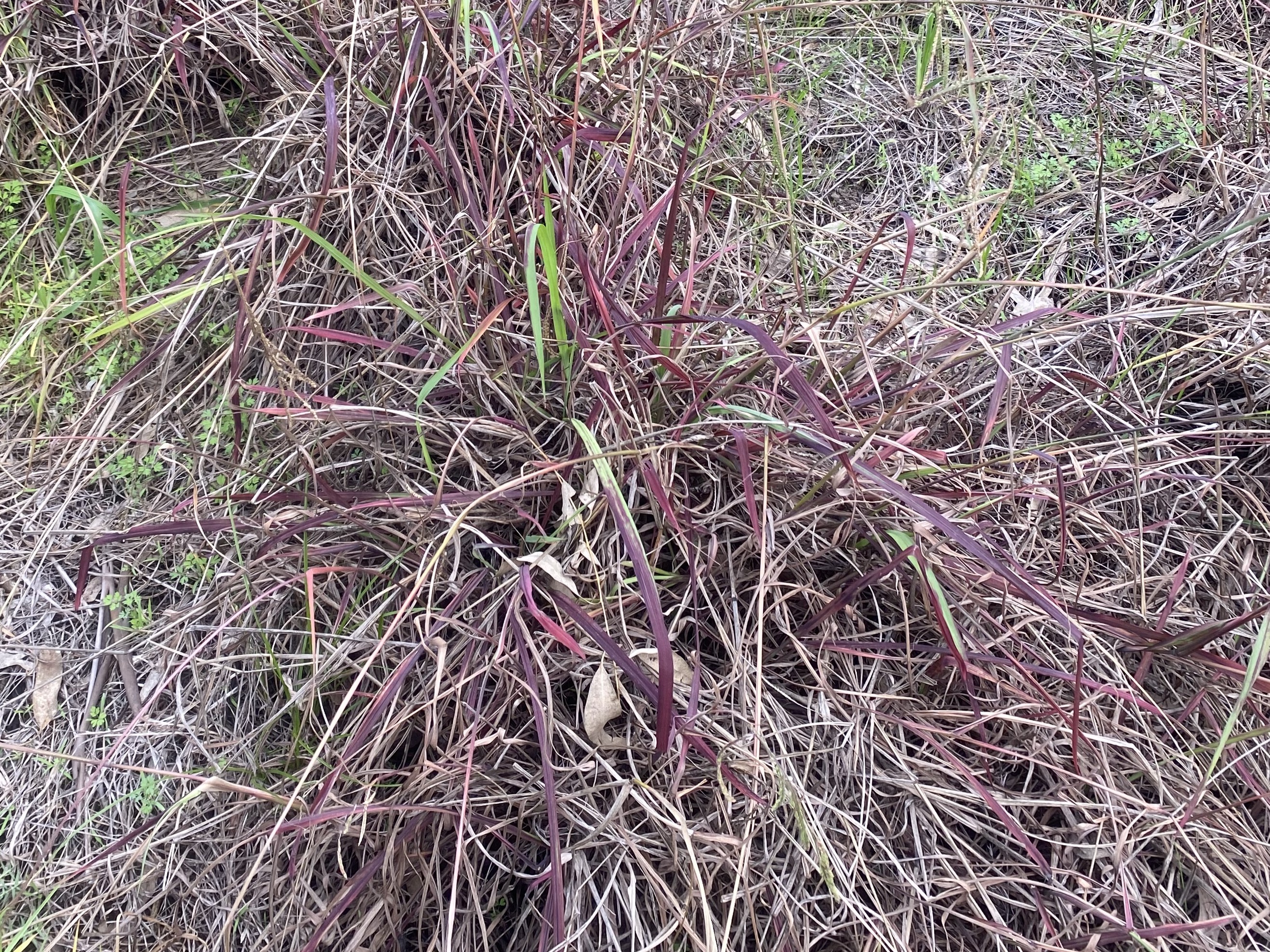
- Yellowing, reddening and purpling of leaves. Leaf discolouration varies with species (Figures 3-5). It starts with the oldest leaves and typically begins at the leaf tip and moves along the leaf blade towards the stem.
- Affected plants become stunted and unthrifty. These plants have fewer leaves and tillers, smaller seed heads and a smaller root system. It starts as small patches which grow and merge to affect large areas. The size of the affected area typically increases rapidly following significant rainfall, especially during late summer and autumn.
- Eventually the affected plants die. This may occur with in a growing season (spring to autumn) or over a longer period.
- Areas where grasses have died are colonised by broadleaf weeds and legumes.
Many of the dieback symptoms can be caused by a range of other factors. These include, but are not limited to: mineral deficiency, moisture stress, cold temperatures, herbicide damage, water logging and nematodes. It is important to eliminate these before assuming dieback. However a combination of symptoms, including a rapid increase of the affected area following significant rainfall and the presence of pasture mealybug are indicators of pasture dieback. More information on symptoms can be found in the pasture dieback identification guide.


Species affected
Pasture dieback affects summer growing grasses. All of the summer growing grasses commonly sown in NSW are susceptible, although some are more susceptible than others. A number of native and naturalised grasses are also affected, however reports of the species impacted and the severity can vary. The severity of symptoms can also vary with region, seasonal conditions and other factors. Dieback has not been reported in temperate perennial grasses in the field.
Species known to be affected in alphabetical order (not by susceptibility) include:
- African lovegrass (Eragrostis curvula) including Consol lovegrass
- Angleton grass/bluegrass (Dicanthium aristatum)
- Bahia grass (Paspalum notatum)
- Black spear-grass (Heteropogon contortus)
- Bambatsi panic (Panicum coloratum)
- Buffel grass (Cenchrus ciliaris)
- Carpet grass (Axonopus compressus)
- Couch (Cynodon dactylon)
- Creeping bluegrass (Bothriochloa insculpta)
- Curly Mitchell grass (Astrebla lappacae)
- Digit grass (Digitaria eriantha)
- Forest bluegrass (Bothriochloa bladhii ssp. glabra)
- Gatton and green panic (Megathyrsus maximus)
- Golden beard grass (Chrysopogon fallax)
- Kikuyu (Cenchrus cladestinus)
- Paspalum (Paspalum dilatatum, P. mandiocanum (syn. P. wettsteinii), P. urvillei and P. plicatulum)
- Purple pigeon grass (Setaria incrassata)
- Queensland bluegrass (Dichanthium sericeum)
- Rhodes grass (Chloris gayana)
- Sabi grass (Urochloa mosambicensis)
- Setaria (Setaria sphacelata)
- Signal grass (Urochloa decumbens)
There are potentially more grass species that are susceptible.
For further information on species susceptibility can be found on the MLA species factsheet.
Cause
Pasture dieback is a complex condition involving pasture mealybug (Heliococcus summervillei). Pasture mealybugs are small sap sucking insects that feed on plants. The adult females are easiest to see with the naked eye (Figure 6). They are white or pink, up to 4 mm long, and covered with a white mealy substance giving them a fluffy appearance. Juveniles have several life stages and can range from 0.2 to 0.4 mm in length. It is the juveniles feeding that causes leaf discolouration in susceptible grasses. The mealybug mainly reproduces sexually and the males are small (less than 1 mm long), winged and often not observed. Pasture mealybugs are mainly dispersed as juveniles by wind.
Mealybug population numbers peak in late summer-autumn. During these times they can be found on leaves of symptomatic grasses, the soil surface and among the plant roots. In high rainfall, warmer environments, such as the NSW North Coast, pasture mealybugs can be found year-round with careful inspection.
During cool or dry periods, mealybugs retreat below ground or under objects such as logs, cow pats and thatch. They can survive on grass roots and deep in the soil profile, emerging again to reinfest plant leaves when conditions become more favourable and susceptible grasses are actively growing.
More information on pasture mealybug can be found in the factsheet.


Can I prevent dieback?
There are currently no options to prevent pasture dieback from affecting susceptible pastures. Its prevalence in a pasture and the severity with which a pasture is affected is influenced by seasonal conditions and management. Actively growing pastures containing highly susceptible grasses which have high biomass are most at risk of being severely affected (Figure 8). A pasture containing less susceptible grasses, with a good legume content that has been grazed is less likely to be severely impacted.
It is recommended that producers practice "Come clean, go clean" to minimise the risk of dieback occurring on their property. Live mealybugs have been found in hay made from tropical grasses (e.g. Rhodes grass), so producers are advised to check the origin of hay purchased.

Managing pasture dieback affected land
Some strategies have been developed to manage pasture dieback in Queensland (Table 1). Recommendations have also been developed for the NSW. These include managing for recovery, improving the pasture, sowing a break crop and controlling pasture mealybug. Talk to your local advisor about the strategies best suited to your situation.
Table 1: Strategies and practices that can be used to manage pasture dieback affected land (Source: DPI Queensland) ✓ = suitable, X = unsuitable, ? = provides inconsistent results
| Practices | Small patch | Widespread | ||
|---|---|---|---|---|
| Arable | Non-arable | Arable | Non-arable | |
| Manage for recovery | ||||
| Adjust stocking rate (forage budget) | ✓ | ✓ | ✓ | ✓ |
| Monitor and treat weeds in bare patches | ✓ | ? | ✓ | ? |
| Improve pasture | ||||
| Sow legumes and tolerant grasses | ✓ | ✓ | ✓ | ✓ |
| Apply fertiliser | ? | ? | ✓ | ? |
| Cultivate | ? | X | ✓ | X |
| Sow a break crop | ||||
| Annual forage (graze or hay/silage) | X | X | ✓ | X |
| Grain or dual-purpose | X | X | ✓ | X |
| Control pasture mealybug | ||||
| Spray pesticide | ? | X | X | X |
| Burn | ? | ? | ? | ? |
Some dieback affected pastures can regenerate from seed in the soil seedbank. To encourage this regeneration, the pasture should be de-stocked to allow the seedlings to establish. Broadleaf weeds should be controlled to reduce competition against the establishing grass. Stocking rates elsewhere on the property may need to be adjusted to match the available feed and prevent overgrazing.
Pastures can be improved by sowing new perennial pastures consisting of legumes and tolerant grasses. To date the only tolerant summer growing grass that has been identified is Brizantha cv. Mekong, however this grass is only suited to high rainfall frost-free environments. On the North Coast of NSW, tropical grass mixes of setaria and signal grass have shown to be relatively tolerant to dieback.
Fertilising will support establishment of a regenerating or newly sown pasture. Cultivating may be an option in some situations. It can have the advantage of aerating the soil, improving water infiltration and encouraging nitrogen mineralisation. However, this method is not suitable in all landscapes and can increase the risk of erosion and can also stimulate weed germination.
Sowing a break crop with alternative forages into affected areas will provide valuable feed or an alternative cash flow (e.g. grain), as well as maintain ground cover to prevent erosion and provide competition for weeds. Winter forage crops or summer broadleaf and forage crops are options. Sorghum may not be suitable as a break crop as pasture mealybugs have been found on forage sorghum plants, although the damage to was thought be negligible. It is not known if other annual forage grasses like maize or millet host the pasture mealybug. When selecting a forage crop, keep in mind other potential pests that may impact the crop, such as fall armyworm.
Controlling pasture mealybugs by either spraying with pesticides or burning has limitations. Firstly, these practices have inconsistent results and only provide short-term relief of dieback symptoms. Secondly, there are no chemicals currently registered for the control of pasture mealybug in tropical pastures. Additionally, because this mealybug lives in and around the crown and roots of the plant, in the soil and in the thatch, full control cannot be achieved by either spraying or burning. Therefore, reinfestation is inevitable from these sources or a neighbouring paddock.
Some options and links to annual and perennial pastures and forages are listed in the table below.
| Forage type | Further information |
|---|---|
| Winter annual legumes (e.g. clovers, medics, vetch, serradella, biserrula) | |
| Summer forage legumes (e.g. cowpeas, lablab, soybeans) | |
| Perennial legumes (e.g. lucerne, white clover, red clover, desmanthus, creeping vigna, forage peanuts) | |
| Herbs (e.g. chicory, plantain) | |
| Brassicas (e.g. forage rape, leafy turnip, bulb turnip) | Forage brassicas |
| Winter cereals (e.g. forage or dual purpose crops: oats, wheat, barley, triticale, rye) | |
| Annual ryegrass | |
Summer forages (e.g. millet, forage sorghum) Note: Sorghum may be a host of pasture mealybug, but productivity losses appear to be negligible. The susceptibility of other summer grass forages is currently unknown. | |
Temperate perennial grasses (e.g. perennial ryegrass, fescue, cocksfoot, phalaris) Note: Field testing is continuing to confirm the tolerance of these grasses. Laboratory screening of perennial ryegrass has indicated cultivars containing the commercial endophytes AR1 or AR37 are tolerant of mealybug. |
Reporting pasture dieback
Help us identify where pasture dieback is by reporting. If you suspect pasture dieback please:
- Visit your Local Lands Services office or ring 1300 795 299
- Contact the Exotic Plant Pest hotline on 1800 084 881
- Email biosecurity@dpi.nsw.gov.au with a clear photo and your contact details or
- Complete the online reporting form
For assistance
Producers requiring assistance identifying or managing pasture dieback can contact their nearest Local Lands Services office or call 1300 795 299.
Further information
- Pasture dieback identification guide
- Pasture mealybug and its role in pasture dieback
- Pasture dieback (NSW LLS)
- Pasture dieback in Queensland (QDPI)
- Pasture dieback (MLA)
- How do I... select grass varieties tolerant to pasture dieback? (MLA)
- Mealybug fact sheet (QUT)
2025 Presentation - Pasture Dieback - Liam Baker NW LLS
References
Anon (2024) Pasture dieback. Department of Agriculture and Fisheries, Queensland. https://futurebeef.com.au/knowledgecentre/pasture-dieback/
