
Buying or adopting a dog
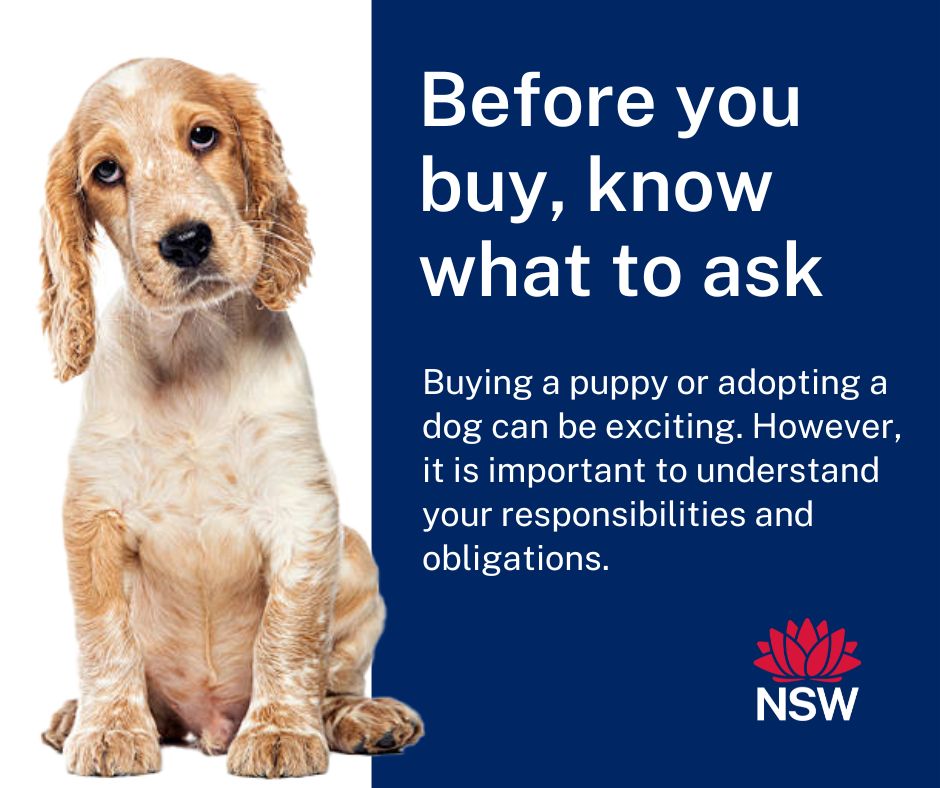
Bringing home a new dog is an exciting time, but it’s important to make sure your new pet will be a healthy and happy addition to your family.
Every year, thousands of dogs in NSW are looking for loving homes. You can give a rescue animal a fresh start by adopting from:
- a council pound or shelter
- an animal welfare organisation
- an animal rehoming organisation.
Rescue animals are usually microchipped, vaccinated, and, if old enough, desexed - with these costs often included in your adoption fee.
Whether you’re adopting or buying from a breeder, asking the right questions matters. This helps you avoid potential problems and ensures your new pet’s health and welfare.
Download our handy checklist below to see the key steps to protect yourself and your new pet.Download checklist for buying a puppy
Pet advertising: What buyers should check
Step 1: Check the advertisement includes required identification details
In NSW, it’s illegal to sell, rehome or give away a dog without a microchip. You can verify a microchip number on the NSW Pet Registry. From 1 December by law, people advertising puppies or dogs for sale or transfer must include certain information as detailed below:
| For dogs born before 1 December 2025 | For dogs born from 1 December 2025 |
|---|---|
|
|
There are some exceptions to these new arrangements:
- If a dog being sold or transferred is 6 months of age or older and the relevant identification and registration information required under the Companion Animals Act 1998 has been recorded in the NSW Pet Registry, the dog’s microchip number is sufficient.
- If a dog being advertised is 8 weeks of age or younger and it is not microchipped, the microchip of the female parent must be displayed and be clearly identified as the female parent. It is important to note that any dog must not be rehomed (sold or transferred) until they are over 8 weeks of age.
- If the dog being sold is a retired greyhound, the greyhound racing industry participant number allocated under the Greyhound Racing Act 2017 may be used in lieu of a breeder identifier number, requirements for the animals microchip number still apply.
Under the new laws, where an advertisement is not made, this information must be provided to the purchaser before or at the time of sale.
Maximum penalties will apply from 1 December for persons not complying with these requirements are up to $82,500 for a corporation; and $16,500 for an individual or imprisonment for 6 months, or both.
Step 2: Verify details on the NSW Pet Registry
Use the identification information to check the NSW Pet Registry to confirm the numbers are valid.
- Microchip search: confirms breed, sex, age, desexing status, registration
- Breeder ID search: shows if the number is active, suspended or cancelled, plus any business names
- Rehoming organisation search: displays organisation details and status
- From 1 December 2025, additional details such as if the breeder identification number or rehoming organisation number is active, suspended or cancelled will be displayed.
Step 3: Transfer ownership after purchase
If you decide to buy a dog the breeder or seller will transfer you official ownership using details on your NSW Pet Registry profile once you’ve confirmed your pet purchase. You’ll receive a confirmation notification from the NSW Pet Registry.
For more details please visit the NSW Pet Registry.
Questions and answers
How can I search for information on a pet using an identification number?
You can access the NSW Pet Registry and search for a microchip number, breeder identification number, or rehoming organisation number.
What do I do if I don't see a breeder identification number in a puppy advertisement?
For puppies born before 1 December 2025, there is currently no legislative requirement for breeders to provide their breeder identification number to a prospective buyer prior to a sale or before accepting a deposit. In these cases, the seller must ensure that at least one of the required identification details is included in any advertisement, which may be the puppy’s microchip number, a breeder identification number.
For puppies born from 1 December 2025, advertisements for puppies must include a microchip number and a breeder identification number. If there is no advertisement this must be provided at time of transfer.
Anyone breeding dogs, from 1 December 2025 whether regular breeders, occasional breeders or those with accidental litters, are required to obtain a breeder identification number. Therefore, if a breeder is not willing to disclose this freely, it could indicate a scam or an unethical breeder.
If you see an advertisement that does not include the relevant identification information, or you suspect an advertisement is misleading or includes a false information, you should lodge a complaint. No breeder identification number on an advertisement for dogs born after 1 December is an offence and is a warning sign that the person selling the pet may not be an ethical breeder.
To find out more about advertising a dog for rehoming or for sale, see the Questions and Answers section of our Selling or transferring a dog page.
I want to buy a greyhound I have seen advertised online, but I can't find the identification number on the NSW pet registry. What do I do?
Racing greyhounds are recorded on the Greyhound Racing Register, which is not public. You can call GWIC on 13 49 42 to check the greyhound’s microchip and whether the seller is a registered greyhound racing industry participant. Once a racing greyhound is sold as a pet, it must be registered on the NSW Pet Registry like other dogs.
Top tips for buying a puppy
Are you ready for the responsibility of owning a pet?
Caring for a pet takes time, energy and dedication. Think about how a dog will fit into your:
- Lifestyle – Will you have time for daily walks, play and care?
- Work schedule – Are you away from home for long hours?
- Holidays – Do you have plans for your pet’s care when you’re away?
- Family dynamics – Are all family members ready for a pet? If you have children, teach them how to safely interact with your new pet. For homes with other animals, check whether the new pet will be compatible and get professional advice if needed.
Pet care costs can stack up quickly. It’s important to research the long-term financial commitment, including:
- Food and bedding
- Vaccinations and vet bills
- Flea, worming, and tick prevention
- Grooming
- Training or puppy preschool
- Emergency care or pet insurance
Understand the breed and animal’s characteristics before you commit. Ask yourself:
- What is the breed’s typical energy level and temperament?
- How long do they usually live?
- Do I have enough time and money to properly care for them?
This will help you choose a pet that suits your lifestyle.
The NSW Office of Local Government provides useful resources on responsible pet ownership. Visit their website for more tips and tools.
How to choose a responsible breeder?
- Research the breeder or seller. If possible and safe to do so, visit the facility where the animal has been bred or is being housed. Are the conditions clean and comfortable? Do the animals and their mother look happy and healthy?
- Check health records. Ensure the animal is up to date with vaccinations, flea and worm treatments and has a microchip.
- Confirm identification details. Check the Breeder Identification Number (BIN) or the Rehoming Organisation Number (RON) located on the advertisement or provided by the seller for dogs sold or transferred in NSW, by putting the number into the NSW Pet Registry.
Avoiding scams - things to consider before you make a purchase
Before making any payments or committing to a purchase:
- Have you been prevented from seeing the animal in person?
- Has the breeder or seller offered to meet in a public place like a car park?
- Have they requested full payment or a deposit before you’ve seen the animal?
- Will the breeder/seller provide you with a documented receipt?
- Are all microchip or identification numbers valid on the NSW Pet Registry?
If you answered yes to any of these, it could indicate a scam or an unethical breeder. Do further checks or report concerns
Know your rights
Did you know you are able to return a puppy within 3 days and receive a 50% refund if the animal is not acceptable for any reason? See section 9 of the NSW Breeding Code of Practice for more information.
If you have purchased a new pet and something has gone wrong, you can contact NSW Fair Trading for information on what to do next.
Get a vet check
Did you know you can ask the breeder to have a veterinarian to conduct a health check before you buy a puppy?
A health check is separate from a vaccination certificate. Vets can perform a health check to help identify any health or breed related health concerns.
How to report a suspected unethical breeder?
If you suspect or have dealt with an irresponsible or unethical breeder or have witnessed animal cruelty, you can report it. Animal welfare inspectors can then investigate your complaint.
Find reporting options on the reporting and enforcement page.