
Port Stephens estuary wide surveillance
2022
Surveillance testing in March was undertaken on a total of 300 oysters collected across 10 zones, to allow additional information to be obtained. QX was detected in cultivated oysters at 7 of the 10 zones tested. However, in 2 of the zones (Bundabah and Soldiers Point) QX was detected only in cultivated oysters that were known to have been moved in January from one of the other five locations testing positive for QX. It is therefore unknown where these oysters became infected with QX. Detection of QX disease in wild oysters was confirmed at 4 of the 10 zones tested (Upper Tilligerry, Lower Tilligerry, Upper Karuah and Oyster Cove).

2023
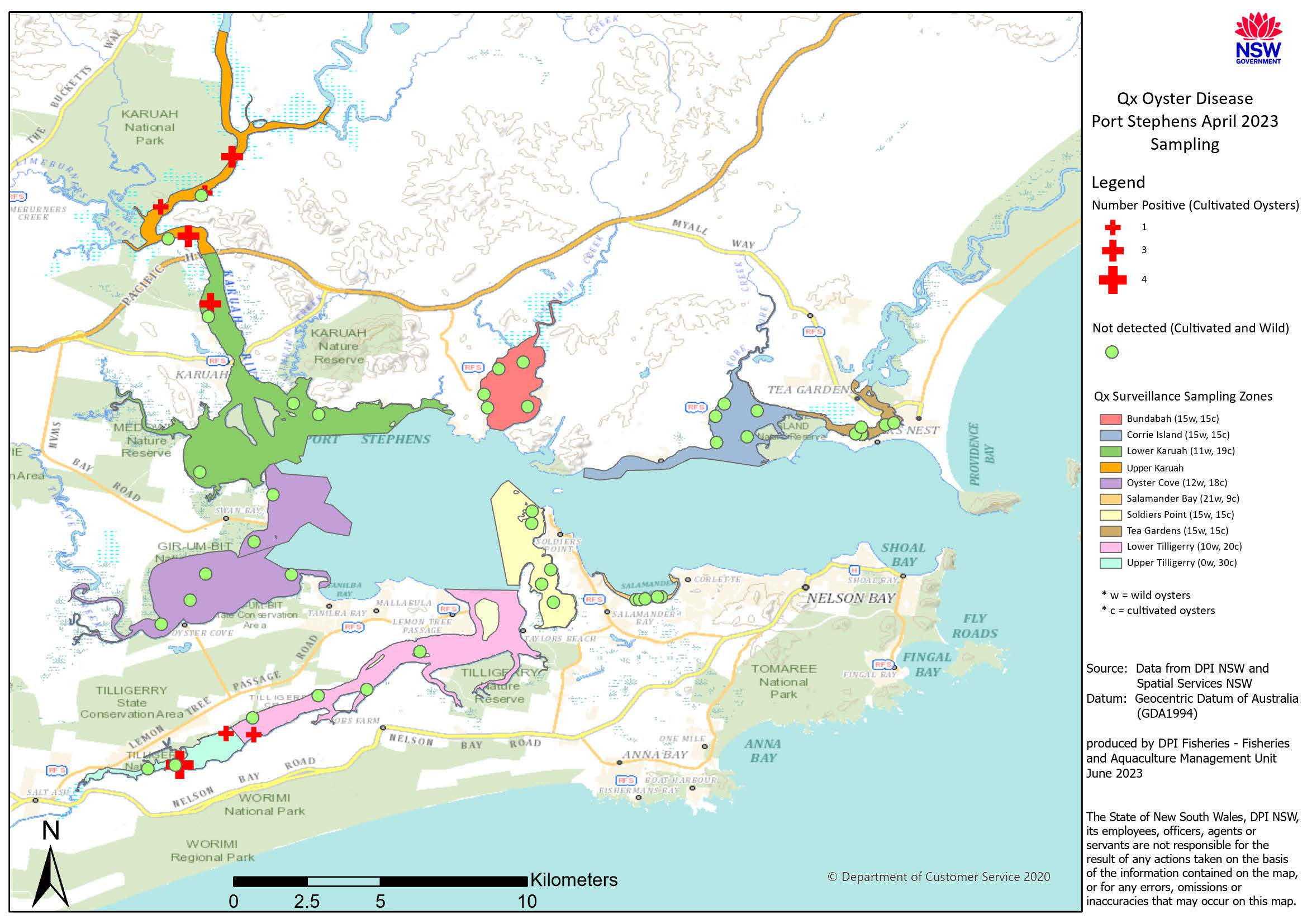
The geospatial survey of Port Stephens was repeated in early April of 2023, with 300 oysters again collected across the same 10 zones. As in 2022, detections of sporulating QX disease were confined to the inner estuary, however in 2023 detections were specifically confined to the Upper and Lower Karuah River and Upper and Lower Tilligerry Creek areas. Oyster Cove was unaffected in the 2023 survey.
2024
The geospatial survey of Port Stephens was repeated in March of 2024, with 300 oysters again collected across the same 10 zones. There were no detections of sporulating QX disease, although a PCR positive oyster was detected in the Lower Karuah River. Despite these results, sporulating QX was detected in oysters deployed in the Upper Karuah River for window of infection studies. In that study, QX disease was detected at a prevalence between 0 and 20% depending on the date of deployment. Notably, no sporulating QX disease was detected in oysters deployed on 14th February and retrieved on 27th March, which was the time period during which the geospatial surveillance work was conducted.
Detections were confined to the inner estuary, however in 2023 detections were specifically confined to the Upper and Lower Karuah River and Upper and Lower Tilligerry Creek areas. Oyster Cove was unaffected in the 2024 survey.

2025
The geospatial survey of Port Stephens was repeated in March of 2025, with 311 oysters collected across the same 10 zones. PCR positives were collected in 8 of the 10 zones, of which the 2 non detected zones were Salamander Bay and Tea Gardens. Cytology positive samples were once again centred towards the inner estuary. Only one cytology positive was observed in a wild oyster which was collected from Lower Tilligerry.
