

Denil baffle plates
Gulpa Creek

Euston Weir fishway Denil section
Murray River

Lock 11 (Mildura) Denil
Murray River

Lock 11 (Mildura) Denil with flow
Murray River

Lock 11 (Mildura) Denil
Denil fishway adjacent the weir

Inserting Denil baffles
Recreational and commercial fishers joined forces to retrofit Jabour Weir (Richmond River) ineffective fishway channel.
Fishway - Denil
The Denil fishway was developed in 1909 by a Belgian scientist, G. Denil. This style of fishway uses a series of symmetrical close-spaced baffles in a channel to redirect the flow of water, allowing fish to swim around the barrier. Denil fishways are generally used on low weirs up to 6 metres high.
This type of fishway is better suited to stronger swimming fish species (larger species or larger size classes) and is not as beneficial for smaller size classes or smaller species who are generally weaker swimmers.
Higher water velocities present in the fishway make fish passage more difficult for some Australian fish species. Due to internal fishway hydraulics, Denil fishways also favour fish species that are bottom/mid water swimmers (such as Australian Bass and Gudgeons) over fish species that swim on the surface (such as Mullet).
Fish passage is further complicated where Denil fishways have been retrofitted into existing steeper-sloped fishway channels (older, ineffective northern hemisphere designs). This can still provide some fish passage to some fish species where previously a total barrier existed.
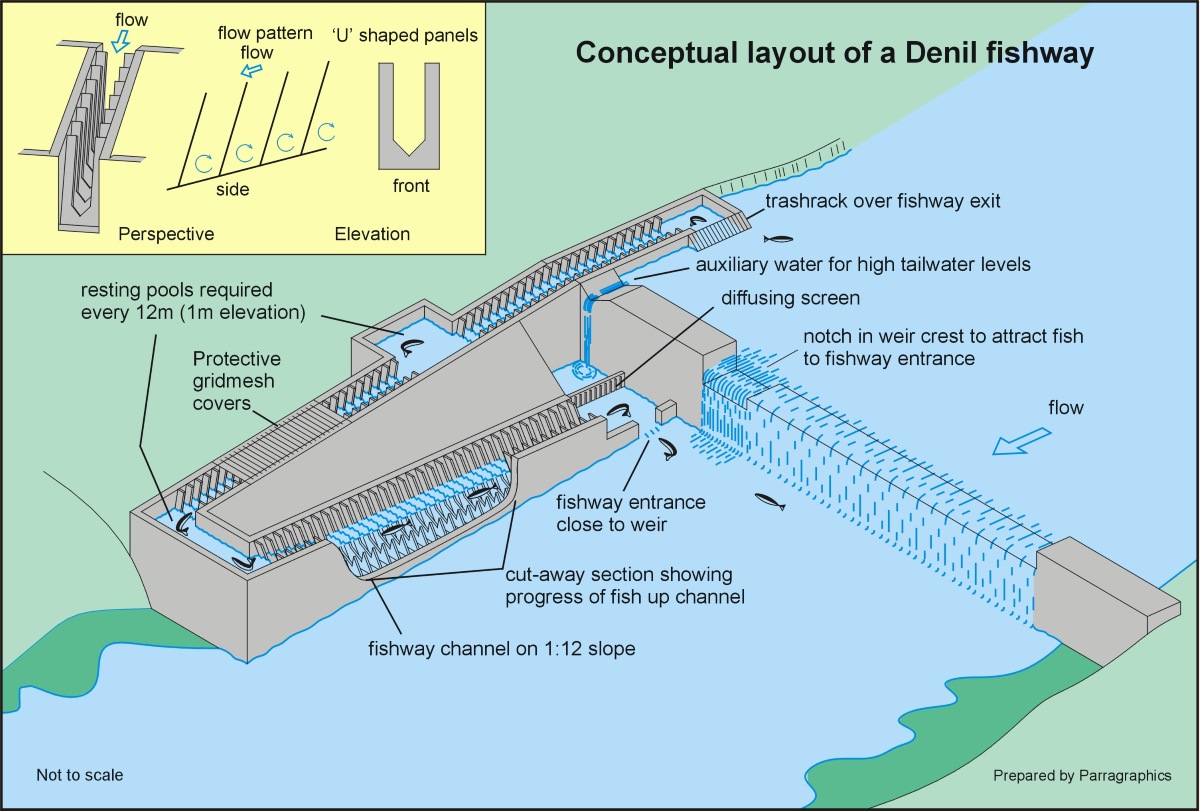
Case Study – Mildura Denil Fishway
As part of the Murray Darling Basin Authority ‘Sea to Hume Dam” program to restore fish passage along the Murray River, a Denil fishway was retrofitted into Mildura Weir. The Denil fishway is essentially separate from the existing weir and can be fully removed during high flows. The fishway can also be progressively removed in stages as tailwaters rise.