
Type and location of the dairy
The NSW planning system is overseen by the Department of Planning, Housing and Infrastructure (DPHI). The planning system has different approval pathways for different types of developments. To determine the planning system’s requirements for a proposed dairy development it is necessary to identify the type of dairy system.
Planning definitions
Dairy
Two types of dairies (dairy systems) are recognised in the NSW planning system:
- Dairy (pasture based)
- Dairy (restricted).
The definitions of these dairies are found in the dictionary of each local council’s local environmental plan (LEP) that applies to the land. How a dairy is defined determines the planning and assessment pathway for any system approval as outlined in Table 2.
| Type of dairy | Local Environment Plan (LEP) definition |
|---|---|
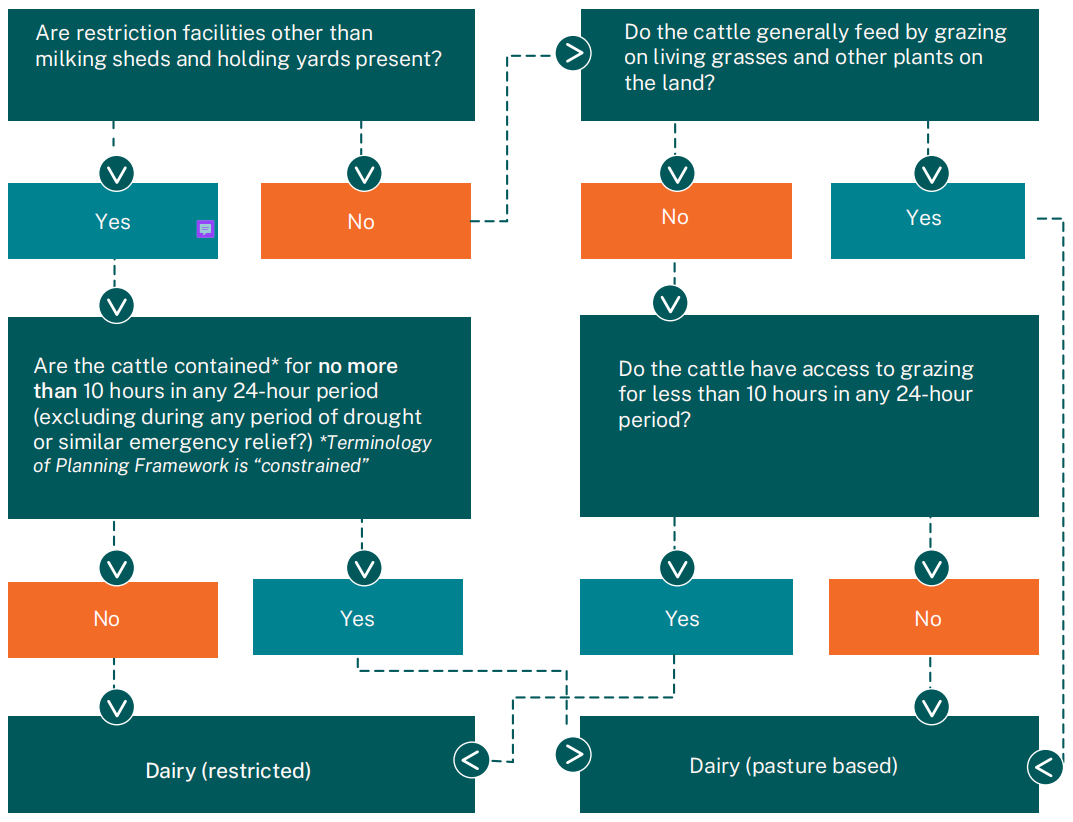
Dairy (pasture based) | Means a dairy that is conducted on a commercial basis where the only restriction facilities are milking sheds and holding yards and where cattle generally feed by grazing on living grasses and other plants on the land and are constrained for no more than 10 hours in any 24-hour period (excluding during any period of drought or similar emergency relief). |
Dairy (restricted) | Means a dairy that is conducted on a commercial basis where restriction facilities (in addition to milking sheds and holding yards) are present and where cattle have access to grazing for less than 10 hours in any 24-hour period (excluding during any period of drought or similar emergency relief). It may comprise the whole or part of a restriction facilit |
Zones and overlays
The NSW planning system applies zones to land through LEPs. These zones reflect the intended use of the land. The zoning and specific overlays that apply to land determines what and how development can be undertaken on that land.
Applicants can use the NSW Planning Portal’s ‘Find a Property’ Spatial Viewer to search for initial information on the planning and zoning rules that affect a property. A property planning report can be freely obtained and used to discuss proposals with local council.
Permissibility
The LEP is the main planning tool for ensuring local development is undertaken responsibly within each local government area. It provides a framework that guides planning and land use decisions through zoning and development controls. The land use table lists land uses as:
- permitted without consent
- permitted with consent
- prohibited.
To determine whether a dairy development can be undertaken on a parcel of land, either with or without an approval, or if it is prohibited, it is necessary to check the
zoning and permitted land uses in the council’s LEP. If a type of dairy is listed as prohibited in the land use table, then that type of dairy cannot be undertaken on the land in that zone.
If a type of dairy is listed as permitted without consent, then development approval is not required.
If a type of dairy is listed as permitted with consent, then it means that development approval is required to develop a dairy farm on land within that zone.
Dairy developments are commonly permitted (with or without consent) in the following zones:
- RU1 – Primary Production
- RU2 – Rural Landscape (in certain areas subject to each LEP)
- RU4 – Primary Production Small Lots (in certain areas subject to each LEP).
While most developments for dairy systems will require development approval, some smaller-scale, lower risk developments (fewer than 50 cattle and in certain locations) may be identified as exempt development, meaning that no planning approval is required on the basis that certain requirements are met. Sometimes the group terms ‘extensive agriculture’ or ‘intensive livestock agriculture’ are listed in the land use table instead of the terms ‘dairy (pasture based)’ and ‘dairy (restricted)’. It is recommended to first seek clarification from the local council on the permissibility of a proposed dairy development.
Changing dairy systems
It is important to remember that making the decision to transition to a different or more intensive dairy farming system, whether seasonal or permanent, may require new or upgraded facilities. The development of these facilities may change the planning requirements. For instance, a ‘dairy (pasture based)’ operation could become a ‘dairy (restricted)’ operation if a loose housing facility is proposed, and the cattle will have access to grazing for less than 10 hours in any 24-hour period.
This would be considered as a change in land use and may fall under a different land use definition within the planning system resulting in different operational requirements. This change should also be checked to ensure that the use remains permitted within the zone.
It is strongly recommended to discuss any plans for new or modified facilities to accommodate a larger herd with council or a planning consultant before entering into construction contracts.
Which type of dairy is proposed?
The definitions are intended to provide a clear distinction for the different types of dairy systems. However, the definitions contain multiple tests relating to facilities and management of the dairy herd which determine whether the business is operating a dairy system based predominantly on grazed pastures, or a dairy system based on a restricted facility feeding system.
Figure 2 illustrates how the presence of certain facilities and/or the management of a dairy herd will determine which definition applies to the proposed dairy development (as per the SI-LEP dairy definitions).
It can be difficult to determine whether the presence of certain facilities on the farm will result in the dairy being classified as either ‘pasture based’ or ‘restricted’. Table 3 outlines the likely dairy definition of NSW dairy farm facilities explained in the Dairy industry terms and definitions.