May 2026
NSW summary
Overview
Above average May rainfall provides relief for parts of NSW
- Rainfall during May has provided relief across parts of NSW, improving on-ground conditions in several regions.
- Rainfall has created opportunities for late sowing of winter crops and supported the establishment of earlier sown crops.
- Available on-ground reports highlight the recent uplift in conditions have increased producer confidence for the season.
- Although the recent rain is beneficial for restoring farm dams in some regions, it will likely not alleviate the coming winter feed gap being managed by livestock producers. Many livestock producers have actioned their drought management strategies early, with destocking, confinement, or lot feeding of stock.
- Despite recent rainfall, production outlooks remain highly dependent on follow-up rain, with ongoing constraints from soil moisture deficits, water supply, feed availability and input costs.
- Recovery from drought is always an uncertain stage for farmers, and there is risk that the benefits of this rainfall may be short lived. The strength and persistence of recovery is dependent on more follow up rainfall.
- At the time of writing, further weather systems were bringing follow-up rainfall to parts of NSW.
Drought conditions persist despite recent improvements
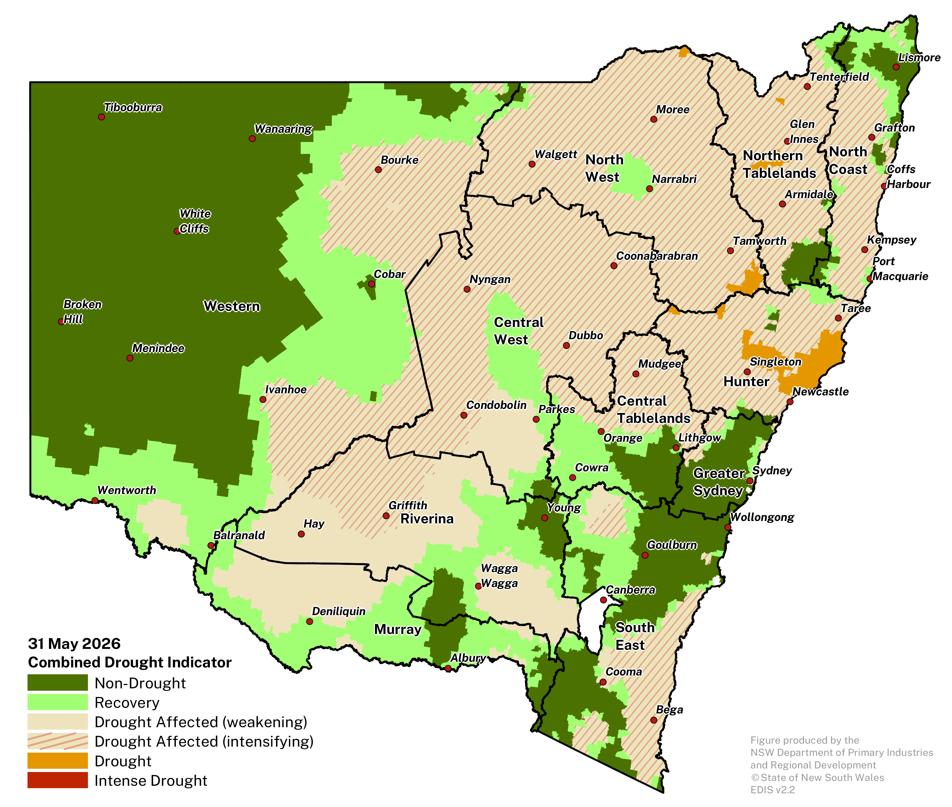
- Recovery continues for parts of the southern, western, and central NSW, although conditions remain varied, depending on location and rainfall received. Further rainfall will build on any recent improvements, with a sustained shift in rainfall patterns over a season typically required to improve the overall outlook for drought.
- In the north, many areas remain in the NSW Combined Drought Indicator (NSW-CDI) Drought Affected category, although the trend in the underling indicators have shifted from intensifying to weakening over the past month.
- The area in any drought category of the NSW CDI has declined to approximately 50% at the end of May.
More detail is available for each LLS region in the regional breakdown section of this Update.
Climate Outlook
The most likely outcome is for drought conditions to persist across much of NSW.
- The Bureau of Meteorology’s climate outlook highlights low to neutral chances (20-50% chance) of rainfall being above the median for the three-month period to 31 August 2026.
- DPIRD’s Drought Forecast is that the most likely outcome is for drought conditions to persist across much of NSW at the end of August. The percentage of NSW most likely to be in any drought category of the NSW-CDI at the end of the forecast period is 55% (with an uncertainty range of 34-66%). More information can be found in the DPIRD Drought Forecast section.
- At a regional level drought conditions will likely intensify across parts of northern tablelands, Hunter and northern NSW. The risk of limited recovery, and a potential return of drought conditions remains for parts of the South East, Murray and Riverina.
Status of El Nino development
- Sea surface temperatures in the eastern equatorial Pacific Ocean, the main influence of an El Niño event, are currently neutral.
- Sub-sea surface temperatures show warmer water moving closer to the surface in the eastern Pacific Ocean.
- International models forecast that an El Niño may develop and continue through winter 2026. However, forecasts have less certainty at this time of the year, due to the autumn predictability barrier.
- If El Niño conditions do develop, the impacts on NSW climate are less clear; ENSO is only one of many drivers that influence weather and climate in NSW. It is important to continue to monitor ocean and atmospheric conditions, along with rainfall and temperature outlooks over the coming months.
More information can be found in the Seasonal Outlook and Drought Forecast sections.