May 2026
DPIRD drought forecast (for 31 August 2026)
(Issued 31 May 2026)
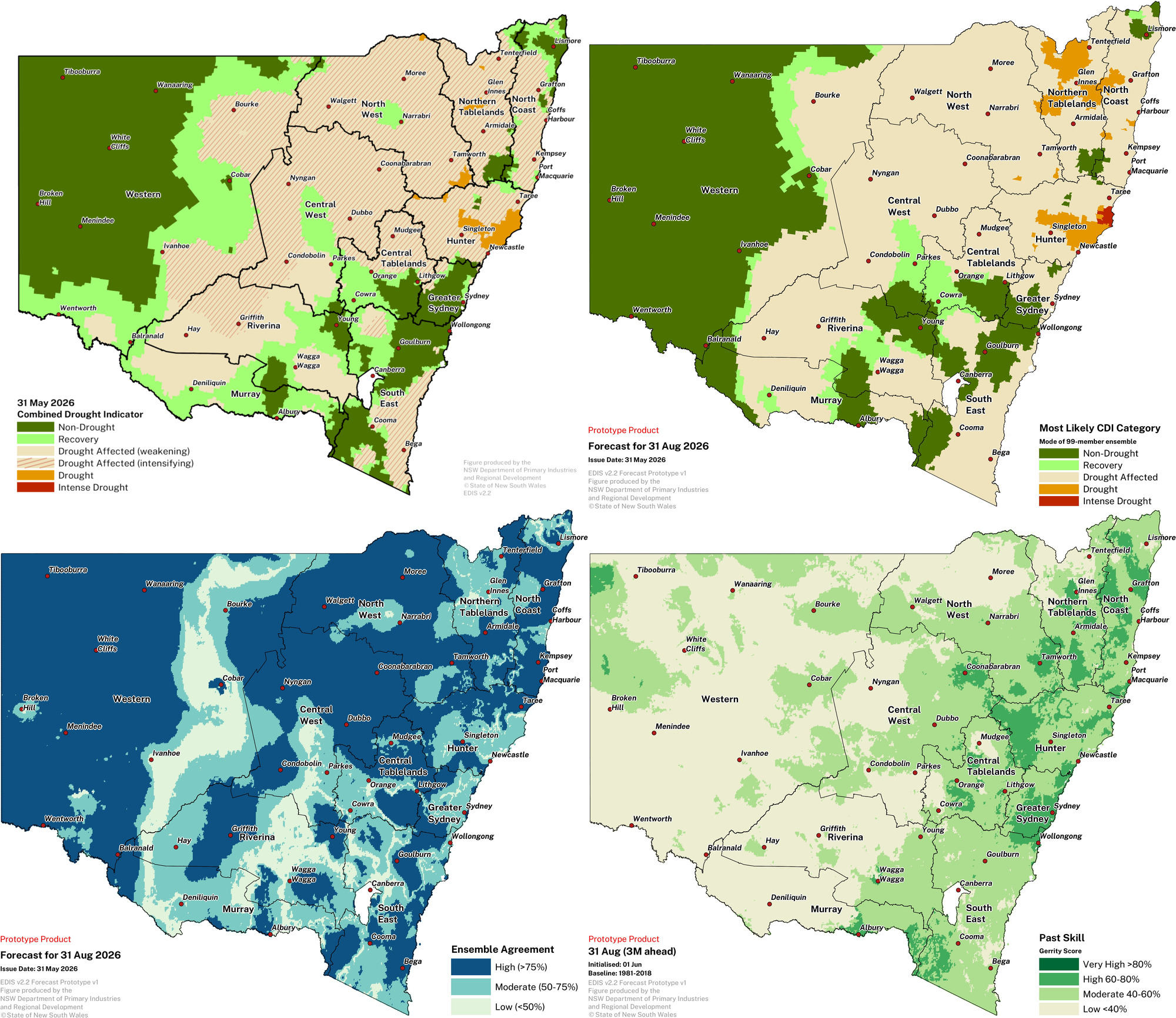
DPIRD’s Drought Forecast (top right) shows the most likely outcome at 31 August 2026.
- The most likely outcome is for drought conditions to persist across much of NSW, with approximately 55% of NSW is expected to be in a drought category by the end of August (with the possible range between 34% and 66%).
- An easing of drought conditions is likely for parts of the western, central and southern NSW regions. However, for some areas, recent recovery will not be sustained, and a transition back into the Drought Affected category is likely.
- Drought conditions will likely intensify in parts of the northeast, Hunter, and southeast. Isolated areas of the Hunter are likely to transition into the NSW-CDI Intense Drought category.
- Despite recent rainfall providing short term relief, the likely continuation and intensification of drought conditions for some regions is being driven by several factors. This includes continued long term soil moisture deficits, ineffective climate conditions for production, along with the increased chance of below median rainfall for this drought forecast period.
Forecast ensemble agreement and historical accuracy vary by region.
- Regions of moderate to low agreement correspond to those areas that are forecast to transition between the NSW-CDI categories.
- Past skill for this forecast period is highly variable, and ranges from low to high for most of NSW.
Table: The forecasted area of NSW in any of the NSW-CDI drought categories
| NSW CDI category | Observed NSW-CDI values | NSW-CDI Drought Forecast | |||
|---|---|---|---|---|---|
| April 2026 | May 2026 | June 2026 | July 2026 | August 2026 | |
| Any drought category (Drought Affected, Drought or Intense Drought) | 57.4% | 49.7% | 45% | 50% | 55% |
| Uncertainity range | 36 - 51% | 32 - 61% | 34% - 66% | ||
The uncertainty range represents the spread between the 10th and 90th percentiles, showing the range within which the forecast is most likely to fall.
DPIRD’s drought forecast uses the Bureau of Meteorology seasonal climate model ensemble to determine the NSW-CDI for the coming forecast period. The drought forecast figure shows the most frequent (mode) drought category in the 99-member model ensemble at the end of the forecast period.
It is important to check forecasts and observations regularly for updates over the coming season.
Forecast releases
Drought Forecast maps are provided twice a month (on the release of the SSU and around the 20th of the month). Check here to see the latest version available. The latest version could be different to the figure below.
Understanding the DPIRD drought forecast figures
Most Likely CDI Category
The DPIRD drought forecast for NSW presents the ‘Most Likely’ Combined Drought Indicator (NSW-CDI) category for the forecast period. The Most Likely NSW-CDI category is determined by identifying the 'mode' of the NSW-CDI. The mode is the category that appears most frequently across all possible forecast outcomes in the ensemble run. It is the most common prediction for drought conditions in the forecast period based on the model's simulations.
This map can be used alongside the most current NSW-CDI map to observe current conditions and the most likely conditions in three months’ time.
Ensemble Agreement
Ensemble agreement refers to the level of consensus on the mode among the ensemble members. When there is high agreement, it means that most of models are predicting a similarNSW- CDI category, suggesting greater confidence in the forecast. If the agreement is low, it suggests that there is a wide range of possible outcomes, leading to greater uncertainty in the forecast.
Past Skill
Past skill refers to how well the model predicts the correct NSW-CDI drought category compared to random climatological chance for every forecast month in the historical record (1981 –2018), allowing an assessment of the reliability of the current forecast. If the model has consistently provided skilful predictions, there is more confidence in its current output. However, if past skill is low, it might suggest a need for more caution in interpreting the forecast, especially when ensemble agreement is low.
Overview of the DPIRD drought forecast
The seasonal drought forecast have been developed as a drought early warning system to prepare for drought events, mitigate drought impacts, and better aid farm and Government management decisions.
The DPIRD drought forecast has been generated by forcing the NSW DPI Enhanced Drought Information System (EDIS) with calibrated forecast variables from the Bureau’s seasonal prediction system, ACCESS-S to produce an ensemble of drought indicators. A 99-member lagged ensemble is used to determine the drought forecast.
A technical description of the DPIRD drought forecast, including a full analysis of the systems skill, is being prepared for public release.
Find out more information about the drought forecast here.
Provide feedback
To provide feedback on the DPIRD Drought forecast, please email seasonal.conditions@dpird.nsw.gov.au
If you want to join our advanced forecast user group and help shape new products register your interest here.
To complete our feedback survey, please click here.