

Tomato brown rugose fruit virus
ToBRFV was detected in New South Wales in July 2025, following earlier detections in South Australia (August 2024) and Victoria (January 2025).
National authorities have determined that eradication is not feasible.
As ToBRFV is now accepted as present in Australia, ongoing detections may occur as surveillance and testing continue. Industry and government will focus on risk management, containment, and maintaining market confidence rather than eradication.
What does ToBRFV mean for NSW stakeholders?
The ToBRFV situation is currently evolving. The NSW Biosecurity (Tomato Brown Rugose Fruit Virus) Control Order came into effect in September 2024 and is still in force. The control measures outlined in the Order are reasonably necessary to prevent, eliminate, minimise and manage the biosecurity risk of ToBRFV. In summary, the movement of a ToBRFV carrier into NSW is prohibited unless sourced from either an unlinked holding (see full control order) or region covered by an Area Freedom Certificate for ToBRFV.
Current ToBRFV market access advice for NSW stakeholders can be accessed here.
Notifiable status
Tomato brown rugose fruit virus is prohibited matter in NSW, and is therefore a notifiable plant disease.
All notifiable plant pests and diseases must be reported within 1 working day. You can report notifiable plant pests and diseases by one of the following methods:
- Call the Exotic Plant Pest Hotline 1800 084 881
- Email biosecurity@dpi.nsw.gov.au with a clear photo and your contact details
- Complete an online form
A full list of notifiable plant pests and diseases can be found in Schedule 2 of the NSW Biosecurity Act 2015, and Schedule 1 of the Biosecurity Regulation 2017.
Description
ToBRFV is a plant virus (Tobamovirus) of tomatoes and capsicums.
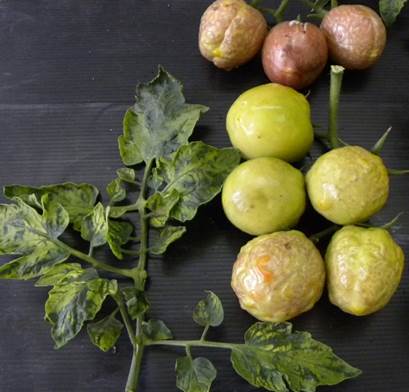
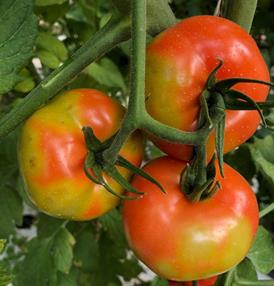
In tomatoes, leaves show symptoms of discolouration, mosaic and mottling patterns (Figure 1) or reduced leaf size. The tomato fruit presents yellowing (Figure 2) or brown areas and wrinkled (rugose) skin (Figure 1). Fruit may also be deformed and have an irregular maturation.
In capsicums, symptoms include leaf deformities, yellowing and mosaic patterns. The capsicum fruit are deformed, with visible yellowing or brown areas or green stripes. Different plant varieties can present different symptoms.
Lifecycle
The lifecycle of ToBRFV is dependent on the living plant host. Following infection, the virus hijacks the cells of the host plant and uses them to replicate.
Spread
ToBRFV is transmitted through propagative material (seeds, plants for planting, grafts, cuttings) and mechanically by direct plant to plant contact, contaminated tools, hands, clothes, trellis wires, greenhouse benches and planting trays.
The virus can remain viable in seed, plant waste and contaminated soil for months or even years.
Host range
Tomato and capsicum species are known to be the primary hosts of ToBRFV. Laboratory testing has thus far not shown potato or eggplant to be hosts. No commercial varieties of tomato are known to have resistance to ToBRFV.
Damage
ToBRFV damages host plant cells leading to death of the foliage and unmarketable fruit. Infected crops may be up to 100% affected.
Once a crop is infected the only control action is destroying all affected plants.
Distribution
ToBRFV was first found in 2014 in Israel, but wasn’t formally identified until 2015 in Jordan. Having a scattered global distribution, this virus has spread to China, Germany, Italy, Mexico, Turkey, UK, and USA (California).
Actions to minimise risk
Put in place biosecurity best practice actions to prevent entry, establishment and spread of pests and diseases:
- practise “Come clean, Go clean”
- ensure all staff and visitors are instructed in and adhere to your business management hygiene requirements
- source propagation material of a known high health status from reputable suppliers
- monitor your crop regularly
- keep records
- isolate tomato and capsicum plants or areas with suspect symptoms to prevent further spread.
It is also encouraged not to bring store bought tomatoes or capsicums into contact with any tomato or capsicum growing farms.
