
Russian wheat aphid
Russian wheat aphid (Diuraphis noxia) is a major field pest of wheat and barley in many grain producing countries. Yield losses of up to 80% in wheat and 100% in barley have been reported overseas. RWA injects toxins into the plant during feeding which stunts plant growth. Heavy infestations may kill plants.
Russian wheat aphid (RWA) can spread by wind, movement of machinery and vehicles, and on people’s clothing.
Current situation
RWA was initially found in South Australia and Victoria in 2016 and was subsequently found in NSW and Tasmania. In spring 2018 and 2023 new detection's of RWA were reported in NSW.
Grain growers and consultants across NSW are urged to continually monitor cereal paddocks for signs of RWA in order to manage infestations effectively.
For more information regarding RWA see: Cesar Russian wheat aphid
What to look for
RWA may be present in mixed populations. If aphids which are commonly found in cereals are observed, it should not be assumed these are the only one's present.
Detection of RWA is most likely by seeing symptomatic plants. Scout for symptomatic tillers in host crops and inspect for aphids. Russian wheat aphid is very small (less than 2 mm) and a 10x magnification hand lens can be used to examine them.
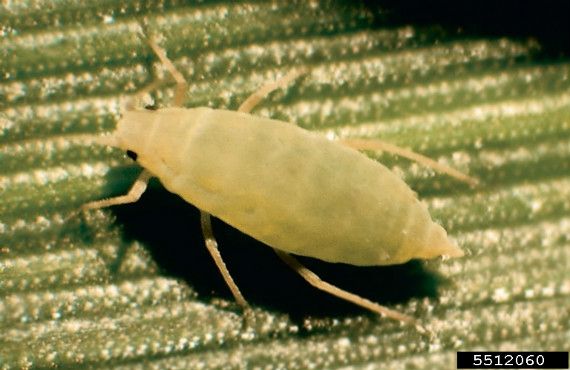
RWA appear quite different to other cereal aphids. They are generally light green in colour, with an elongated body shape, distinctive black eyes and lack visible ‘exhaust pipes’ (siphunculi).
Symptoms associated with the presence of RWA include:
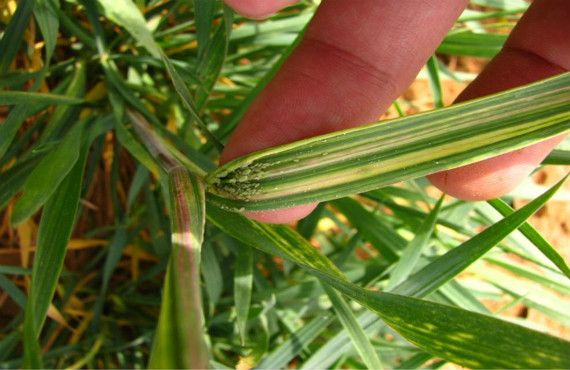
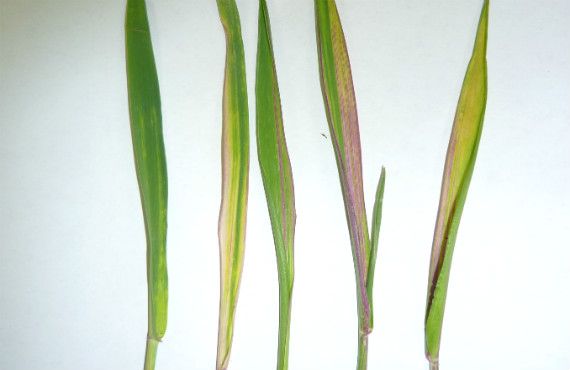
- Leaves with white, yellowish and red streaks
- Leaf rolling along margins
- Awns trapped by rolled flag leaves
- Heads with a bleached appearance
Hosts
RWA has a wide host range on grasses (Poaceae family). Primary hosts for RWA support the entire lifecycle and allow reproduction to occur. These include wheat (Triticum aestivum), barley (Hordeum vulgare), and durum wheat (Triticum durum).
Secondary hosts are plants that support adults and final instars only. These hosts allow the aphid to survive but not to reproduce. Secondary hosts include oats (Avena sativa), rye (Secale cereale) and triticale (X Triticosecale).
While many grass species are considered hosts of RWA it is not known which native Australian grasses are suitable hosts.
Life cycle
In its native range, the lifecycle of RWA includes sexual and asexual phases. However, like most other introduced aphids in Australia, RWA reproduces asexually with females giving birth to live female offspring clones.
RWA is more suited to cooler temperatures than other cereal aphids. Survival of aphids outside the shelter of leaf rolls is affected by exposure to rainfall, drying winds, predators and parasitoids.
When populations are low, the vast majority of aphids are wingless. As aphid densities increase, the proportion of winged aphids increases.
Spread
In autumn, aphids that have survived on volunteer cereals and grasses may infest host crop seedlings soon after emergence.
Wingless RWA are generally found in 'hot spots' which become larger with increased aphid densities rather than spreading evenly across a crop. Dispersal between paddocks, farms and regions is more likely to occur through the movement of winged RWA travelling on wind currents. Aphids may also spread on machinery, vehicles and clothing.
Damage
Aphids feed in dense colonies, typically at the base and sheath of younger leaves and within curled leaves. Toxins injected by the aphid during feeding destroy chlorophyll and prevent carbohydrate formation. Heavy infestations can kill plants.
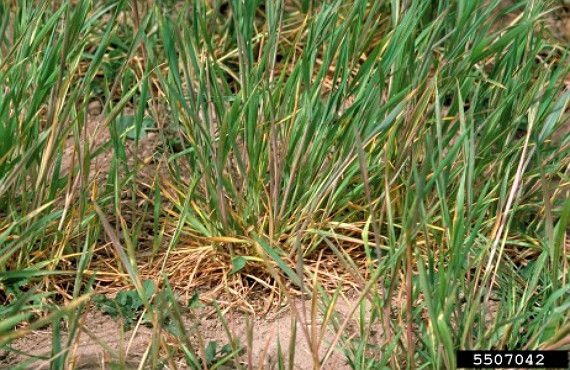
Low aphid populations can cause symptoms to appear as early as 7 days after infestation. Damage symptoms are characterised by longitudinal rolling of leaves and whitish, yellowish to pink-purple chlorotic streaks along the length of leaves. Viewed from a distance, damage may appear as a general loss of colouration across the affected crop area.
Heavily infested plants are often stunted and may appear flattened, with tillers lying almost parallel to the ground. The most severe damage usually occurs when plants are stressed. As the crop develops awns may become trapped by rolled leaves, resulting in hook-shaped, bleached and sterile heads.
Russian wheat aphid management
Monitoring
Inspect crops regularly from seedling emergence to soft dough stage. Aphids can be found in crops at any stage but are difficult to spot when numbers are low. RWA numbers and the percentage of affected tillers should be monitored from stem elongation to head emergence (Z30-50). During inclement weather RWA is found on the newest leaves and in leaf sheaths. In fine weather and in high populations aphids can be dispersed all over the plant.
Russian wheat aphid has been found in mixed populations with other cereal aphids such as oat and corn aphid.
Inspect plants for the characteristic leaf streaking and rolling. Inspect crop edges on the windward side or adjacent to infested grasses. Russian wheat aphid is known to favour areas that are stressed or have less ground cover. Populations may first appear in 'hot spots' but may spread through the crop in heavy infestations.
Hygiene
Farm hygiene can slow the spread of RWA between farms and fields. RWA can spread by movement of machinery and vehicles and on clothing. Keep traffic out of affected areas and minimise movement in adjacent areas.
It is important to put hygiene practices into place to reduce the risk of transporting pests and diseases on clothing, footwear, vehicles and machinery when moving between paddocks and farms.
If symptoms of suspected RWA are observed, it is important to change clothing (including hats) and clean footwear and vehicles before entering another paddock or farm. People entering crops should consider wearing disposable coveralls and changing these between farms. Used coveralls should be bagged and securely disposed of. Clothing worn in a suspected infested crop should be bagged, sealed and washed before being worn again.
Control volunteer cereals and grasses in fallows during summer and autumn to prevent an early build-up of RWA in winter crops.
Cultural control
A vigorous and dense plant canopy will inhibit RWA development. Agronomic practices to promote crop vigour will reduce the impact of RWA on yield.
Chemical control
Refer to the APVMA PubCRIS database for the most up to date labels.
Chemical control should consider economic thresholds, (RWA action threshold calculator) insecticide resistance in other crop pests, natural pest enemies and beneficial insects as part of integrated pest management.
GRDC has released a comprehensive manual to guide Australian grain growers and advisers on best management practice to minimise the economic impact associated with infestations RWA.
Beneficial insects
Preserving populations of beneficial insects is a key management strategy for managing aphids. Beneficial numbers increase as temperatures increase and can provide control in spring to prevent RWA population build up.
RWA is attacked by a range of natural enemies including lady beetles, lacewings, damsel bugs, some parasitoids and entomopathogenic fungi.
Publications