

Cucumber green mottle mosaic virus
| Primefact number | Edition | Published | Author |
|---|---|---|---|
| 1723 | Second | Jun 2025 | Plant Biosecurity and Product Integrity |
Cucumber green mottle mosaic virus is a serious plant pathogen affecting cucurbits such as cucumber, melons, and pumpkin. It is not a notifiable pest in NSW. It is highly transmissible and is readily spread via contact with infected plant material. Once established at a site it can be difficult to manage.
Pest Status
Cucumber green mottle mosaic virus (CGMMV) is a pathogen primarily affecting cucurbits. It was first detected in Australia in the Northern Territory in 2014, and in New South Wales (NSW) in 2019. It is now established in NSW and is not a notifiable pest. There is no requirement to notify NSW DPIRD if you find it on your property, and there is no penalty if it is detected.
It is important to note, that in New South Wales everyone has a general biosecurity duty to prevent, eliminate, or minimise biosecurity risks they are aware of, whether they are exotic or established. This includes the spread of plant pathogens, such as CGMMV.
There are no CGMMV specific restrictions on movement of host material into or within NSW. Other states have restrictions. If you intend to move CGMMV host material or equipment that has been used in the cultivation of host material from NSW to another state or territory familiarise yourself with regulations of the receiving jurisdiction.
Description
Cucumber green mottle mosaic virus (CGMMV) is a plant virus of the genus Tobamovirus. There are at least five strains of the virus affecting fruit and vegetables of the plant family Cucurbitaceae.
Symptoms typically present within 7-14 days of infection. Progression and severity of symptoms is influenced by host species, cultivar, temperature, and growth stage. Infection at early growth stages typically results in more severe symptoms which may fade with age. Plants grown in pots are more affected.
Symptoms are difficult to detect in seedlings, although cotyledons may turn yellow. The virus affects all parts of the plant from the roots to the leaf tips, even the fruit and trichomes on the stems. Removal of visibly affected material does not stop the spread of infection to other plants. It is important to note that even if plants are asymptomatic, they remain infectious.
Symptoms vary between plant host species, cultivar, and strain of the virus; however, mosaic mottling of leaves is the most frequently observed. Common symptoms include:

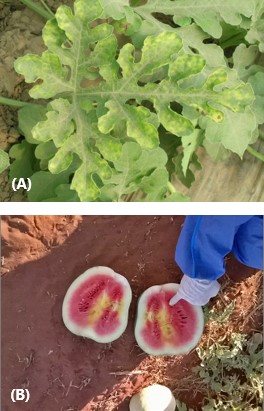
- Watermelon: Development of mottling and mosaic symptoms on leaves and stems and peduncles develop brown necrotic lesions. Foliage may develop a bleached appearance and wilt. Plants or runners may die prematurely. Blistering of leaves and leaves may become thinner. Deformed fruit, ring or mottle on the rind, uneven ripening, internal discolouration and sponginess (Figure 1).
- Cucumber: Green mottling on young leaves and fruit surface. More severe infections can result in interveinal chlorosis (yellowing) in leaves, blistering of leaves, crinkled new growth, stunted growth, and deformed fruit (Figure 2). Infected plants may collapse
- Melon: Mottling and mosaic symptoms on young leaves, fruits may be malformed and present with mottling and surface netting.
- Pumpkin, squash, zucchini: Foliage may be asymptomatic or present with mottling and mosaic symptoms. Pumpkin fruit is always asymptomatic, but squash and zucchini may have internal symptoms such as discolouration and necrosis, even if the surface of the fruit looks normal.
Symptoms are similar to those caused by other pathogens which makes visual identification of CGMMV unreliable.
Damage
CGMMV is the most economically important Tobamovirus affecting cucurbits and there is no cure. CGMMV may cause a yield loss of 15% to 50% in cucumber and watermelon through both reduced yield and poor fruit quality. Plants that are otherwise symptomless may still experience yield reduction.
CGMMV does not pose a risk to human health, and the risk of transmission to other plants from infected fruit is considered low. Fruit from plants infected with CGMMV is safe to eat, however visual symptoms may make it unsuitable for market.
Distribution
CGMMV is known to occur in Asia, Europe, North America, Australia and parts of Africa.
In Australia, CGMMV has been reported in the Northern Territory, Western Australia, Queensland, South Australia and New South Wales.
Disease cycle
CGMMV systematically infects host plants, meaning all plant tissues (leaves, roots, stem, etc) contain the virus. It infects new hosts by entering small wounds on healthy plants. These may be caused by plants rubbing against each other, abrasions from being handled or stepped on, or from pruning and harvesting activities. The virus requires living plant tissue to replicate; however, it can survive outside of a host for extended periods of time.
CGMMV is also spread in seed, with virus particles in the seed coat infecting the germinating seedling.
CGMMV can persist in dry plant material for several years, making contaminated plant waste and the remains of roots in soil or media a long-term source of infection. CGMMV can remain viable in root material in soil for 12 months in well aerated soil and up to 36 months in waterlogged soil.
Host range
Natural infection has been observed in 29 host plants across 9 plant families. Most hosts are cucurbits, but hosts can also be found in other families. Known hosts include:
- Commercial: Ash gourd (Benincasa hispida), bottle gourd (Lagenaria siceraria), watermelon (Citrullus lanatus), West Indian gherkin (Cucumis anguria), melon (Cucumis melo), cucumber (Cucumis sativus), pumpkin (Cucurbita maxima and Cucurbita moschata), zucchini (Cucurbita pepo), ridged gourd (Luffa cylindrica), bitter gourd (Momordica charantia), snake gourd (Trichosanthes cucumerina), ridged gourds (Luffa acutangular), balsam apple (Momordica charantia).
- Weeds: Eosuri (Heracleum moellendorffii), common heliotrope (Heliotropium europaeum), bells of Ireland (Moluccella laevis), blackberry nightshade (Solanum nigrum), Indian ginseng (Withania somnifera), various Amaranth (Amaranthus) species, fat hen (Chenopodium album), pigweed (Portulaca oleracea), bitter apple (Citrullus colocynthis), squirting cucumber (Ecballium elaterium), headache bryony vine (Cucumis maderaspatana), turnsole (Chrozophora tinctoria), common thornapple (Datura straomonium).
Spread and management
CGMMV can be introduced to a production system in seed or seedlings grown from infected seed. Once present, it is highly transmissible and is readily spread by contact with infected plants. This can be via direct plant-to-plant contact—primarily through leaf-to-leaf or root-to-root transmission—or indirectly via contaminated tools or equipment. Once CGMMV has been introduced to a site it can be very difficult to eradicate. Even if all host crops are removed it can survive for years in plant debris, or for months on the surface of infrastructure and equipment.
Limited wind-assisted transmission of CGMMV is thought possible through movement of contaminated abrasive material, such as soil particles.
The virus can be spread via water, including irrigation sources and overland flow.
There are no known insect vectors of CGMMV. However, CGMMV has been isolated in pollen, honey, and adult honeybees. Honeybees have been shown to infect healthy plants by moving infected pollen from plant to plant. Animals, such as birds or pests can spread the virus via contact with infected plants.
What to do if you suspect CGMMV on your property?
Confirm it is CGMMV
The only way to confirm the presence of CGMMV is to send a sample to a lab for identification. If you have plants displaying symptoms of CGMMV and wish to confirm infection to inform management decisions NSW DPIRD provides plant health testing services through the Plant Health Diagnostic Services (PHDS) unit.
To submit a sample:
- Sample fully expanded leaves (symptomatic where available) from the suspect plant(s). Where possible include some stem material as this can help the sample stay fresh. You can submit up to 10 leaves within a single sample; these may be from the same plant, or from different plants.
- If collecting samples from multiple plants be sure anything that has come into contact with a suspect plant is disinfected before being used on another plant.
- Wrap the leaves in dry paper towel and place into a resealable bag.
- Place the bag containing the samples into another resealable bag along with a completed Plant Health Diagnostic Service Specimen Advice Form.
- Post the sample to PHDS, see the link below for delivery details and contact details for the customer service team. Where possible post samples early in the week to avoid delays over the weekend.
For more information on sample preparation, packaging, and test costs see the NSW DPIRD website.
While waiting for the results of the test, consider taking measures to minimise further spread. This may include isolating suspect plants by restricting access or preventing staff from working on the block/tunnel. If plants must be handled, wear disposable PPE (e.g. gloves or disposable coveralls) to minimise contact with suspect plants. Equipment that contacts suspect plants should be disinfected before use in other production areas.
CGMMV management options
If CGMMV is confirmed at your property, options for managing the disease include:
- Changing production to non-host crops.
- Attempt eradication through crop destruction and decontamination.
- Continue growing cucurbits while managing infection levels to minimise impact.
Your decision may be influenced by factors such as crop stage at time of infection and level and impact of the infection. You may employ aspects from several strategies, such as planting non-host crops in areas with high levels of infection while managing infection in others.
Change to a non-host crop
CGMMV only impacts cucurbit crops and changing to non-host can be an effective way of minimising the economic impact of the virus. Planting non-host crops may be part of a larger eradication strategy as without host plants CGMMV will eventually be eradicated from a site. If you intend to return to growing cucurbits keep in mind that CGMMV can survive in the plant matter in the soil for several years, and that weeds may act as a reservoir for the virus.
Crop destruction
To continue growing CGMMV host crops in production areas where CGMMV has been found, measures should be taken to remove the virus from the growing environment and all equipment and structures associated with an infected crop disinfected for future use.
Options for destroying the virus in host plant material include:
- Burning
- Deep burial away from water sources.
- Composting. Temperatures must reach 72°C for several days to destroy CGMMV.
Infected plants should be removed and destroyed, as well as those neighbouring plants that may have come into contact with an infected plant. Given the transmissibility of CGMMV, once a crop is infected the risk of spread through the rest of the crop is high. Equipment that has been in contact with the plants, such as string, stakes, growing media bags and mulch, should also be destroyed. Plant debris, such as pruned material, should be disposed of along with the infected plants.
When disposing of plant material be aware that you have the potential to spread CGMMV. Wear gloves and protective, preferably disposable, clothing. Ensure, that any equipment (e.g. wheelbarrows, shovels, etc) are disinfected before leaving the contaminated management unit and that no plant material or soil is stuck in wheels etc. Make sure loads are covered to prevent infected material blowing into healthy crops.
Decontamination
Once infected host plants have been removed, all structures and equipment used to grow crops should be decontaminated. See
Table 1 for chemicals and rates approved by the APVMA for use against CGMMV. Several common disinfectants do not work against CGMMV, including:
- Alcohol based disinfectants
- Hydrogen peroxide applied at label rates
- Products based solely off quaternary ammonium compounds (e.g. Virex, Lysol)
The products listed in Table 1 have been shown to be effective against CGMMV.
Decontamination begins with thorough cleaning to remove dirt and algae buildup so disinfectant can reach the surface and concludes with disinfection of all structures and equipment (e.g. glasshouse/polytunnel, seedling trays, benches, irrigation lines). A multi-step process using several rounds of cleaning and disinfection has been found to be the most effective for decontaminating infected sites. Contact time is important, if the product is not left for long enough disinfection may not be effective.
- Pressure wash or thoroughly clean all surfaces and equipment with a disinfectant to remove all gross matter and other contaminants that may interfere with the final disinfection step.
- Rinse with water and apply a second round of disinfectant. This does not need to be applied with a pressure washer. Leave for indicated contact time. Ensure that the chemical used is suitable for use on the surface being cleaned. Rinse with water again.
- For porous surfaces, such as concrete, additional treatment should be considered. In controlled temperature environments increasing the temperature may aid efficacy as long as wetting times are not impacted.
Please note that some of the products in Table 1 may be caustic, corrosive, have phytotoxic effects or require specialised PPE to use. Prioritise your safety when working with these products.
Agricultural chemical product users must always read the label and any permit before using the product and strictly comply with the directions on the label and the conditions of any permit. Users are not absolved from any compliance with the directions on the label nor the conditions of the permit by reason of any statement made in or omitted from this publication.
Table 1. Chemical suitable for disinfection of CGMMV at APVMA approved rates. Purpose indicates ow the chemical can be used to control CGMMV.
| Active Ingredient | Example Product | Purpose | % active in formulated product | % active in final solution | Contact time (for solid surfaces) |
|---|---|---|---|---|---|
Alkyl dimethyl benzyl ammonium chloride, dodecyl dimethyl ammonium chloride, glutaraldehyde* | S, T, E, F | 0.5% | 1 hour | ||
Potassium peroxymonosulfate | Virkon S (Tablets) (Powder) | S, P, E, F, I | 49.4% | 1% | 1 hour |
Benzoic acid | S, T, E | 9% | As per label instructions (0.36%) | As per label instructions | |
Sodium hypochlorite* | Various (e.g. liquid chlorine, bleach) | S, P, T, E, I | Variable** | 1% | 1 hour |
Purpose indicates how the chemical can be used in the control of CGMMV: S = solid surfaces; P = porous surfaces; T = tools; E = equipment; F = fogging; I = irrigation systems.
* Use of some products containing sodium hypochlorite as the active ingredient are only approved for use under permit (PER12818). Ensure your use of the product meets the conditions outlined in the permit.
**Carefully read product label when mixing. Mix to a final solution of 1% available chlorine e.g. if product contains 42 g/L active chlorine then use 250 ml of product per litre of water.
Managing infection
The goal of ongoing management is to reduce the impact of CGMMV by controlling the level of inoculum (the amount of a pathogen) in the environment and implementing sound biosecurity and hygiene practices to minimise potential spread.
Control inoculum by removing sources of potential infection:
- Create a weed free buffer area around the growing area. Key weed species to remove include blackberry nightshade, fat hen, pigweed and thornapple.
- Monitor the crop and quickly remove plants that display symptoms of CGMMV.
- Rather than letting pruned material sit on the ground, dispose of it as quickly as possible. Gathering pruned material directly into wheelbarrows or trolleys then removing it also prevents movement of infection on shoes from walking over infected plant material.
- Once a crop is finished remove old plants as soon as production is finished and remove volunteer cucurbit plants as quickly as possible.
- Dispose of contaminated soil or growing medium. If you are unable to disinfect or replace contaminated soil or growing media, as may be the case when planting directly into the ground, the use of an intermediate medium has been found to reduce infection rates. By first planting into clean medium, wounds on the roots of seedlings caused during planting are not directly exposed to sources of infection. These plants and medium are then inserted into the contaminated soil.
Once a primary source of inoculum has established at a site the virus can spread rapidly. Mechanical transfer is a major pathway through which CGMMV spreads to new hosts and standard management practices which require handling of plants, such as pruning, harvesting, or spraying, can quickly infect an entire crop if no precautions are taken. Most surfaces or materials that come into contact with an infected plant are potential pathways through which CGMMV could spread, including:
- Hands and skin.
- Clothing and PPE, especially footwear which can transport soil or plant material.
- Tools, equipment, and machinery.
- Packaging materials e.g. pallets, packing boxes, bins.
- Vehicles, in particular tyres and footwells which may house soil or plant debris.
- Infrastructure, such as glasshouse or polytunnel walls, benches, mats, and floors.
- Trellis and poles/stakes.
- Irrigation, both the equipment and water itself. CGMMV may spread through recirculation of nutrient solutions. Flow irrigation spreads the virus further than drip irrigation.
- Pots or growbags.
- Soil or growing media.
In an ideal world any equipment or clothing that comes into contact with a plant, symptomatic or not, should be disinfected before being used on another plant. This is not practical at a farm level but you could consider implementing biosecurity zones within your property e.g. isolating individual greenhouses. Any equipment, clothing, and footwear moving from one zone to another should be disinfected. This minimises exposure to potential sources of infections. To help with this:
- Establish footbaths at key locations, such as entry to production areas, or between glasshouses or polytunnels. Ensure footbaths are filled with appropriate disinfectants which is replaced often to ensure the disinfectant is actively working (Table 2).
- Most chemicals cannot penetrate soil or plant matter, so provide stiff brushes or hoof picks for visitors to remove organic matter prior to using footbaths.
- Provide spray bottles of disinfectant and disposable PPE, such as nitrile gloves, at the entrance to production areas or management zones to facilitate disinfection of tools and equipment.
- Always work on clean crops first, then move to suspect or infected crops.
Table 2. Disinfectants suitable for use in footbaths against CGMMV at APVMA rates.
Active Ingredient | Example product | % active in formulated product | % active in final solution | Contact time |
|---|---|---|---|---|
Sodium hypochlorite | Various (e.g. liquid chlorine, bleach) | Variable** | 1% | 10 seconds |
**Carefully read product label when mixing. Mix to a final solution of 1% available chlorine e.g. if product contains 42 g/L active chlorine then use 250 ml of product per litre of water.
Actions to minimise risk
The best defence against pests, diseases, and weeds on your farm is to implement sound biosecurity practices. It is more cost-effective to prevent pests getting on your farm in the first place than it is to eradicate or manage them once there. Anything that involves movement of people, plant material, or other items that may carry pests or pathogens poses a biosecurity risk. Below are some suggested actions to minimise the risk of CGMMV being introduced to your property. This is not a comprehensive list; consider developing a biosecurity management plan for your property to assess the specific biosecurity risks associated with your operation.
Staff and visitors
- Restrict access to visitors and contractors: only allow people into production areas if it is necessary.
- Maintain a visitor log which records details such as name, contact details, and reason for visit.
- Conduct a basic risk assessment of anyone seeking to enter production areas e.g. have they recently visited other locations where host crops are grown, if so, did they enter production areas or handle plants?
- Ensure that everyone understands their biosecurity obligations and what is expected of them. Conduct site inductions with visitors, providing training to employees, and place signs at key points (e.g. foot bath stations).
Tools and equipment
- Any tools or equipment entering the site should be disinfected before being allowed into production areas.
- Establish a washdown area where any equipment or materials can be decontaminated prior to entry.
- Wear gloves when handling plants. If handling multiple plants, then change gloves or disinfect between plants.
Vehicles and machinery
- Always practice come clean, go clean. All vehicles and machinery entering and exiting production and packing areas should be free from mud, dirt, and plant material. When cleaning vehicles:
- Park the vehicle on a hard surface
- Use high pressure water to remove gross matter. Target areas that are frequently exposed to dirt and plant material, such as wheel arches, tyres, side steps, and the underbody of the vehicle.
- Apply a suitable disinfectant to the outside of the vehicles as well as any interior parts of the vehicle exposed to dirt, such as floor mats and foot wells.
- Passengers should disinfect footwear in a footbath.
- Rinse the disinfectant from all surfaces.
- Inspect any vehicles and machinery before they enter production areas.
- Where it can be avoided outside vehicles should not enter production areas. Have them park in designated parking areas and transfer passengers to dedicated farm vehicles that only operate within production areas.
- Have a designated parking area for visitor vehicles that is away from production areas. Keep the area free from weed and ensure runoff does not drain into production areas or irrigations sources.
- Use signs to inform visitors about property access points and parking areas.
Farm inputs
- Do not recycle packaging, new materials should be used for each crop batch. Store unused materials away from host plants.
- Water can carry diseases. Only use new irrigation equipment. Treat water to reduce risk of spreading diseases. Where possible divert runoff from production areas away from irrigation sources.
- Source seeds or planting material from reputable suppliers, do not use seed, seedlings or grafted material provided by other growers.Use seed that has been tested by a certified laboratory
