
Herbicides
Control techniques using herbicides
Foliar spraying
Foliar spraying can be used on a wide variety of weeds in situations where all of the foliage can be covered by the herbicide mixture. Foliar spraying has potential for spray drift and off-target damage. Marker dye is useful to help show treated areas.
Foliar spraying includes spot spraying and blanket spraying.
- Spot spraying targets individual weeds or small areas of weeds. It is also used to follow up after initial control to treat regrowth.
- Blanket spraying covers a larger area than spot spraying. Selective herbicides are often used for blanket spraying e.g. herbicides that only kill broad leaf plants and not grasses.
Foliar sprays can be applied using
- Boom sprayers which are usually attached behind a tractor. They can quickly treat large areas with infestations up to 1 m high.
- High volume handguns may be used for taller infestations or in areas that are difficult to access. The handgun is connected by a hose to a herbicide tank and pump, carried by a tractor or vehicle.
- Knapsack or backpacks are suitable for smaller infestations and areas that cannot be accessed by vehicles.
Spraying with a gas gun/splatter gun
Gas guns or splatter guns apply a low volume of high concentration herbicide to the weeds. They are suitable in steep or other difficult to reach areas and for dense infestations of weeds. The herbicide is squirted from a gas-powered gun, placing very large droplets onto the leaves from 6–10 m away. The splatter is arched over the tops of bushes and down their sides, at specific intervals.
For some applications, only a small portion of the foliage needs to be treated , minimising off-target damage and reducing chemical usage. Follow the label to determine the coverage required. Marker dye is useful to help show treated areas.
Rope/wick applicators
A wick or rope is soaked in herbicide that is pumped from a reservoir (either by hand or with a 12-volt pump). The wetted wick is used to wipe or brush herbicide over the weeds. Commercially available equipment such as wick wipers are available in sizes ranging from hand-held to vehicle- or tractor-mounted.
Manual wiping
Manual wiping is labour intensive but can be useful for small infestations especially when treating weeds that are very close to desirable plants. Commercial hand held weed wipers are available. Gels or herbicide mixtures are applied to the leaves and or stems. Check
the label or permit for information about the number of leaves that need to be covered
e.g. some gels state that half of the rosette leaves need to be wiped.
For soft plants, use a hard tool (e.g. knife blade) to provide resistance down the back of the stem or leaf, while manually wiping herbicide down the front.
Vehicle or tractor mounted wiping in pastures
For machinery mounted wipers, ensure weeds are at least 15 cm above species to be retained. Apply herbicide when weeds are actively growing. Heavy grazing before application will help keep the desirable pasture plants lower to the ground than the weeds. In ungrazed areas, slash or burn and allow for regrowth to target weeds species. If possible, conduct two passes in opposite directions to obtain sufficient coverage of weed foliage.
Ground speed should not exceed 8 km/hr. Calibrate application so that wiper remains moist but does not drip excessively, and a continuous patch of weeds does not receive more than the amount of herbicide that would be applied using a broadacre treatment.
Basal barking
Basal barking controls thin-barked woody weeds and trees. It is also an effective way to treat saplings, regrowth, multi- stemmed shrubs and weeds in inaccessible areas such as steep banks. This method creates little or no spray drift or off-target damage. It can control difficult-to-kill weeds at any time of the year. Do not apply to wet bark or plants with very thick bark.
Mix an oil-soluble herbicide with diesel (or in some cases biodiesel, or kerosene). Spray or brush the herbicide mixture all the way around the trunk or stem of the plant, from ground level to a height of 30 cm (check labels as heights may vary) (Figure 1). It is important to saturate the full circumference of the trunk, and to treat every stem or trunk arising from the ground.
The diesel helps move the herbicide through the bark and into the underground storage organs of the plant, slowly killing it.
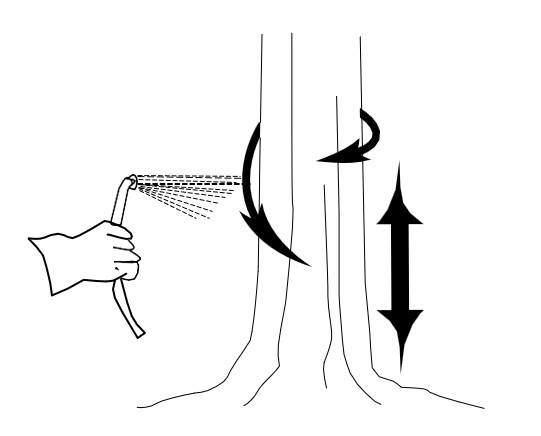
Stem injection methods
Stem injection is used on woody weeds such as trees and large shrubs. Only weeds that can be safely left to die and rot should be treated this way. If the tree or shrub is to be felled after treatment, allow it to die completely before felling.
Cut or drill holes through the bark into the sapwood tissue all the way around the trunk. Apply the herbicide to the holes or cuts within 15 seconds. The aim is to reach the sapwood layer just under the bark (the cambium layer), where the herbicides will be transported throughout the plant.
Stem injection - drill and fill method
This method is for trees and woody weeds with stems or trunks greater than 50 cm in circumference. Use a battery-powered drill to make downward-angled holes in the sapwood approximately 5 cm apart (Figure 2). Herbicide is then injected in measured doses using a backpack reservoir and syringe.

Stem injection - axe cut method
The axe cut method can be used for trees and woody weeds with stems or trunks greater than 50 cm in circumference. Use an axe or tomahawk to make horizontal cuts into the sapwood all the way around the circumference of the trunk (Figure 3). While still in the cut, lean the axe or tomahawk out to make a downward angled pocket. This allows the herbicide to pool. The herbicide is then immediately injected into the pocket or if using a gel herbicide apply a layer of gel to the lower surface of the cut, Cuts should be close together usually 2- 4 cm apart. This method is also referred to as frilling. Do not ringbark the trunk, as this will decrease the uptake of the herbicide into the plant.

Chain saw or pruning saw method
This is very similar to the method above except that the cuts are made by saws. Make the cuts using a downward action so that the herbicide will stay in the cut rather than flow down the stem.
Stem injection is used on woody weeds such as trees and large shrubs. Only weeds that can be safely left to die and rot should be treated this way. If the tree or shrub is to be felled after treatment, allow it to die completely before felling.
Cut or drill holes through the bark into the sapwood tissue all the way around the trunk. Apply the herbicide to the holes or cuts within 15 seconds. The aim is to reach the sapwood layer just under the bark (the cambium layer), where the herbicides will be transported throughout the plant.
Stem injection - drill and fill method
This method is for trees and woody weeds with stems or trunks greater than 50 cm in circumference. Use a battery-powered drill to make downward-angled holes in the sapwood approximately 5 cm apart (Figure 2). Herbicide is then injected in measured doses using a backpack reservoir and syringe.
Stem injection - axe cut method
The axe cut method can be used for trees and woody weeds with stems or trunks greater than 50 cm in circumference. Use an axe or tomahawk to make horizontal cuts into the sapwood all the way around the circumference of the trunk (Figure 3). While still in the cut, lean the axe or tomahawk out to make a downward angled pocket. This allows the herbicide to pool. The herbicide is then immediately injected into the pocket or if using a gel herbicide apply a layer of gel to the lower surface of the cut, Cuts should be close together usually 2- 4 cm apart. This method is also referred to as frilling. Do not ringbark the trunk, as this will decrease the uptake of the herbicide into the plant.
Chain saw or pruning saw method
This is very similar to the method above except that the cuts are made by saws. Make the cuts using a downward action so that the herbicide will stay in the cut rather than flow down the stem.
Cut stump
This method is used for trees, shrubs and woody vines with thick trunks. The advantage of this method is that the weed is removed immediately.
Cut the plants at the base (preferably no higher than 15 cm from the ground), using a chainsaw, axe, brush cutter or machete.
Apply herbicide to the exposed surface of the cut stump emerging from the ground (some labels also include applying herbicide to the sides of the stump) (Figure 4). Coloured dye helps to mark the stumps that have been treated. Apply the herbicide as soon as the trunk or stem is cut. A delay of more than 15 seconds between cutting and applying the chemical will give poor results. Dispose of the cut plant appropriately. Some plants can regrow if left in contact with the soil.
This method is more efficient with two operators working as a team. The herbicide can be applied:
- from a knapsack
- with a paintbrush
- from a drench gun
- using a hand spray bottle
- as a gel from a squeeze bottle.

Cut and paint
This method is similar to the cut stump method. It is suited to smaller vines and multi-stemmed shrubs. Completely cut the stems close to the ground. Apply herbicide immediately to the cut surface emerging from the ground. Apply the herbicide using a paint brush or gel applicator.
If the vines have aerial tubers (e.g. madeira vine), both ends of the cut stems must be treated with herbicide.
Stem-scraping
Stem-scraping is mainly used for vines. Use a sharp knife to scrape a very thin layer of bark from a 15–30 cm section of the stem. Do not scrape all the way around the stem (Figure 5). Immediately apply herbicide to the exposed soft underlying green tissue. Paint the herbicide on with a brush or applicator for gels. In the case of madeira vine, all tubers within reach should be collected, removed and composted or destroyed before starting the scraping. The bark can be peeled off some woody weeds.

Tree spearing
This method uses a specifically designed tree spear. Thrust the spear into the tree at an angle of 30° to 40° from the vertical. This cuts the tree and applies the appropriate amount of herbicide. The process is repeated, forming a row of cuts approximately 5 cm apart all the way around the tree.
Granular applications
Granular herbicides are applied to the soil under weeds. No water or other liquids are added when applying the granules. The labels give rates per m2. The granules may be distributed aerially or on the ground using a calibrated applicator.
The best time to apply the granules is before a rainfall event, but not if the rain is likely to cause run-off.
Capsule injection
Capsule herbicides contain water-dispersible herbicide granules. They are used for woody weeds.
Measure the circumference of the trunk and read the label to determine the number of capsules and the spacing between the holes. Each trunk needs to be treated on multiple- stemmed plants.
An applicator is used to drill a hole and deliver each capsule into the sapwood layer beneath the bark. The hole is then plugged to retain moisture and allow the herbicide to translocate through the tree.
Dissolvable tablets
Dissolvable effervescent tablets effectively control some species of water weeds. The tablets can control floating, submerged and emergent water weeds. Anyone using this type of herbicide needs to complete specific training. You must calculate the volume of water to be treated before applying this type of herbicide. The tablets may be placed directly into the waterbody to dissolve, or they can be dissolved in water and sprayed onto emergent waterweeds.
Applying herbicides: managing your legal responsibilities
The following legislation details legal requirements for the safe use and storage of pesticides:
- NSWPesticidesAct1999
- NSW Pesticide Regulation 2017
- The Work Health and Safety Act 2011
- Work Health and Safety Regulation 2017.
Legislations can be viewed online
Herbicide users must always read the label and any Permit, before using the product. Users must comply with all directions on the label and the conditions of any Permit.
All herbicide users should take reasonable care to protect their own health and the health of others when using herbicides. They should also make every reasonable attempt to prevent damage to the environment. Damage includes off-target drift onto sensitive areas or harm to endangered or protected species.
Records of herbicide use
All commercial herbicide users must keep records of their herbicide application. Records must be:
- completed as soon as practicable, no later than 48 hours after use
- kept for three years.
The NSW Pesticide Regulation 2017 includes a list of information to be recorded. Details are available via the NSW Environment Protection Authority (EPA) website.
Accreditation
The Pesticides Regulation 2017 states that a person must not use or engage a person to use a pesticide unless the applicator is qualified. Domestic use, such as home gardens, is excluded, provided the pesticide is a specific domestic/home garden product.
The minimum qualification is AQF2, unit code AHCCM201 Apply Chemicals under Supervision. This allows use of pesticides under the supervision of someone accredited with the AQF3.
To be AQF3 accredited these units must be completed:
- AHCCM307 Prepare and apply chemicals to control pest, weeds and diseases
- AHCCM304 Transport and store chemicals. These units are valid for 5 years.
A Ground Applicators Licence may also be required in some situations. Details about licences are online.
Examples of training organisations include:
Spray drift
All herbicides must be applied in a way that minimises drift hazards. Minimising drift maximises herbicide effectiveness on target weeds and. reduces damage to and/or contamination of off-target crops, pastures and environmental areas. There are moral and legal responsibilities to prevent herbicides from drifting. Even small quantities of drifting herbicide can cause severe damage to highly sensitive plants.
Many labels have drift reduction recommendations that must be followed. These recommendations include wind speed, temperature, droplet size and buffer zones.
Information about limiting spray drift is available on the Australian Pesticides & Veterinary Medicines Authority (APVMA) website.
Withholding periods
Withholding periods are legal requirements that are listed on all herbicide labels. The withholding period is the minimum period of time that must elapse between:
- the last application of a chemical (herbicide) to any plant, crop, or pasture, and
- the harvesting, cutting or grazing of animals on the plant, crop or pasture or the shearing, slaughter, collection of milk, or collection of eggs from animals grazed on the plant, crop or pasture.
This is to ensure that the chemical’s residues in the treated produce fall below the maximum permitted level known as the Maximum Residue Limit.
Herbicide resistance
Herbicide resistance is the inherent ability of a weed to survive treatment with a herbicide that would normally kill that species. If a resistant plant is allowed to reproduce, the resistance spreads resulting in more resistant plants. This is different from poor herbicide performance. Once herbicide resistance occurs it will persist indefinitely.
Herbicides act by interfering with specific processes in plants, known as the herbicide’s mode of action. Herbicides with the same modes of action are grouped from Group 0 to Group 24 (previously groups A to Z). The herbicide groups are on the herbicide labels.
The risk of herbicide resistance developing is higher in certain Groups. One example is that, Groups 1 (previously group A) and 2 (previously group B) are more likely to develop resistance than Groups 4, 22 and 9 (previously Groups I, L and M)
Manage herbicide resistance by combining herbicide use with non-chemical control options, also by:
- ensuring any resistant plants do not set seed
- monitoring the results of herbicide treatments and looking for resistant plants
- undertaking herbicide resistance testing on suspect plants that survive herbicide treatments
- not relying on the same herbicide Group for regular weed control (rotate treatments using herbicides from different Groups).
Adjuvants
An adjuvant is any herbicide additive, used to improve effectiveness. There are a wide number of adjuvants available for different purposes. The three main types of adjuvants used include:
- Non-ionic surfactants (e.g. BS1000), which reduce surface tension of spray increasing coverage. They also reduce the average droplet size and increase spray drift risk.
- Oil + surfactant mix (e.g. Uptake®), which can increase spray adherence and coverage. They increase average droplet size.
- Penetrants (e.g. Pulse® Penetrant (organosilicone), which reduce the surface tension of the spray solution. They increase coverage and can facilitate spray movement through the leaves. Penetrants may increase drift risk and will evaporate from the leaf surface over a few hours.
Additional adjuvant may also be recommended on the label or permit when:
- higher application volumes are recommended causing a dilution of the existing adjuvant and potentially reducing herbicide retention on the leaf surface
- the target weed is difficult to wet due to its leaf surface such as waxy or hairy.
Always read the herbicide and adjuvant labels. More information about adjuvants is available on the Grains Research and Development Corporation (GRDC) website.
Minor-use permits
Minor-use permits allow for an ‘off-label’ use of a registered herbicide. The Australian Pesticides & Veterinary Medicines Authority (APVMA) issues permits based on careful decisions about the stability and efficacy of a herbicide product for a particular use and the extent to which use of the product might pose economic, environmental or social risks.
Before using a herbicide under a permit issued by the APVMA, users must obtain a copy and read the permit. Users must comply with the details, critical use conditions and restrictions.
Permits are available via the APVMA Permit portal.