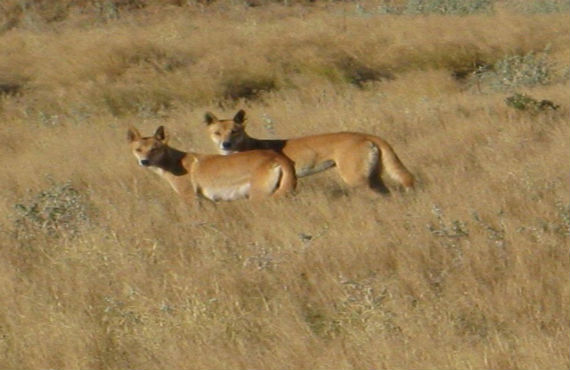
- Wild dogs are found in a wide variety of habitats including urban areas.
- Wild dog attacks on livestock and domestic pets can have a significant financial and emotional impact on people and animals affected by the attacks.
- Wild dogs spread diseases that affect livestock, pets, native animals and humans.
 Description
In NSW the term ‘wild dog’ refers to all wild-living dogs (Canis familiaris) and includes dingoes, feral domestic dogs and the hybrid descendants of these.
Wild dogs are predominately golden or yellow but can also be white, black, black and tan, brown, brindle, patchy and any combination of these.
Weights of adult wild dogs generally range from 11 to 25kg for males and 7 to 22kg for females.
Distribution
Wild dogs are found across NSW, however, the eastern ranges, the coastal hinterland and tablelands have the highest populations. Increasingly, wild dogs are found close to towns where they intermingle with local dogs and can become mis-identified as 'strays'. The wild dog is highly adaptable and may live successfully in arid to rainforest environments, providing there is an adequate supply of food, water and shelter.
Diet
Wild dogs mostly eat fresh meat and carrion. Food habits vary between locations and seasons, for example, wild dogs will eat fruit, scrapes from rubbish tips and plaguing insects when available.
Domestic livestock can constitute a portion of the wild dogs' diet in agricultural areas, but common prey items include small to medium-sized animals such as wallabies, rabbits, possums, wombats, echidnas, birds, reptiles, rodents and other small mammals.
Most preferred prey is hunted by individual dogs but when prey availability changes, wild dogs will form packs to hunt larger prey such as cattle and kangaroos. Sheep and goats can be hunted by individuals or small groups working together.
Surplus killing occurs when a predator attacks and either kills or injures several prey animals, such as kangaroos or sheep that are excess to the predator's nutritional requirements.
This behaviour occurs with many predators including wild dogs and foxes. Resulting multiple domestic livestock losses can be devastating for livestock producers.
Reproduction
Wild dogs:
- usually breed once a year, bitches come into season during April and May
- gestation lasts for 63 days (about 2 months)
- will typically have 4-6 pups in a litter but can be 1 -11 pups
- pups are born in a den which can be a hollow log, soft ground under large rocks, caves or dense vegetation and these can be used in successive years
- pups are weaned at 6 – 8 weeks but stay with the adults until 6 – 12 months of age
- some bitches may breed in their first year.
Social Structure
Wild dogs have a flexible social system. Each member of the group occupies a home range which overlaps with those of other wild dogs to various extents.
Members of a social group meet and separate over time or rely on vocal communication. This explains why some wild dogs are mostly seen as individuals.
Cohesion within groups and separation between groups is maintained by a variety of communication methods. Scents in urine and faeces, marking via scratching or raking the ground, and vocalisations are all used.
When individuals meet, facial expressions and body postures are used to communicate dominance or submission. Aggression between animals is not uncommon and is used to establish or maintain social position.
Home range and movement
Wild dogs may move throughout the day and night but are mostly active at sunrise and sunset and least active during the middle of the day.
Individual home ranges vary from 400 to 100,000 ha, averaging about 4000Ha in size in eastern NSW and up to 90,000 ha in dry western environments.
As could be expected, areas with the greatest food sources and key water points within home ranges are used most frequently and other parts may be rarely visited.
Movements often follow well defined paths along topographic features. The shape of the territory is often determined mostly by topography and distinguishing features such as mountain spurs or rivers forming boundaries.
Life span and mortality
There is a high mortality rate among young wild dogs with those that survive living for about 5 – 7 years.
Impacts
Wild dogs may significantly affect livestock production, the environment and community.
In agricultural production areas they can:
- prey on sheep, cattle, goats and poultry
- injure and maim animal which then either require treatment or euthanasia
- harass livestock causing them to be flighty, miss mother their offspring, have poor weight gain and reduced wool production
- attack domestic dogs including working dogs.
Environmental impacts may include:
- prey on native species that have endangered or venerable populations, including smaller mammals like koala and bush tailed rock wallabies
- spreading diseases that can affect native animals.
Social impacts include:
- emotional impacts on people when wild dog attacks occur
- threat of injury from wild dog on humans and their pets
- conflict within communities in relation to personnel views on the place of wild dogs in the environment and the preservation of ‘dingo’ populations.
Disease Spread
Wild dogs carry a range of parasites and diseases that affect livestock, wildlife and domestic pets including:
- sheep measles
- hydatidosis
- mange
- distemper
- hepatitis
- parvovirus
- Neospora caninum
- Toxoplasmosis
Wild dogs can transmit roundworms, hookworms and hydatids to humans.
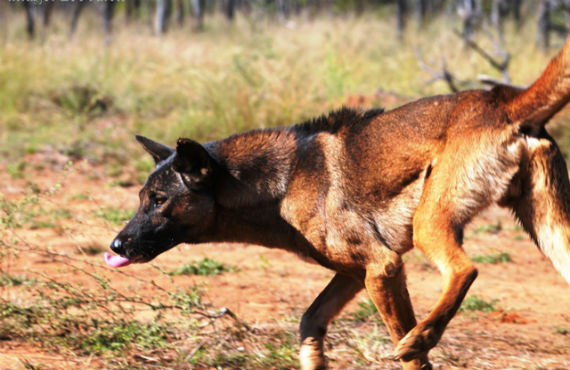
Wild dog management
The focus of wild dog management should be on reducing the impacts of wild dogs.
For this to happen it requires a strategic and proactive approach including:
- private and public land mangers working together across landscapes and tenure
- an understanding of the planning framework that underpins a collaborative and integrated approach
- where appropriate being a part of control programs and Wild Dog Management Groups.
Key planning documents include:
- The NSW Wild Dog Management Strategy 2022-2027 (PDF, 564.05 KB)
- Regional Strategic Pest Animal Management Plan for each Local land Services region
- Regional/Local Wild Dog Management Plans.
Control options
Baiting
1080 and PAPP are used to bait wild dogs with a variety of bait types available as either pre-prepared or fresh bait material.
Both poisons are available from a Local Land Services Authorised Control Officer. However, they are regulated and issuing of bait material is based on meeting legislative requirements.
Most wild dog control programs are coordinated in association with Local land Services staff and may involve local landholder groups, Landcare and Wild Dog Management Groups.
Shooting
Shooting is not a primary control technique for managing wild dogs. Shooting may play a role in managing the impact of a wild dog that is known to visit a particular property or paddock and is affecting livestock production.
Trapping
Trapping wild dogs is best conducted by experienced or trained operators. Only soft-jawed or padded jawed spring traps may be used for the control of wild dogs in NSW.
Traps are best used in conjunction with other control techniques and may be very effective after a coordinated baiting program to control wild dogs that did not pick up a bait. Trapping is often the only means of removing some problem dogs.
Fencing
Barrier fencing may include conventional and electric fencing, or electrified outrigging of conventional fences. Barrier fencing may only provide an effective barrier to wild dogs providing it is adequately maintained.
Conventional fences are generally not as effective a barrier as kangaroos, wombats and feral pigs quickly create holes in the fence, leaving an opening for a wild dog. Two electrified outriggers on fences can be a more effective barrier. When designing electric fences, it is important to consider the behaviour of wild dogs. As a general rule, wild dogs prefer to push through, push under or dig under the fence.
Most land managers upgrade existing old fences with electric outriggers or construct a much cheaper all-electric fence. Electric barrier fences are of particular help when a property adjoins wild dog habitat or when neighbours neglect control. Regular maintenance and the incorporation of a monitoring system into the fence will assist supervision.
Livestock guarding animals
Guard dogs have been used for centuries in Europe to protect sheep and goats from wolves and, more recently, in America against coyotes. Guard dogs take many forms and the Maremma is the most common breed.
Recent research indicates when properly trained and maintained, guard dogs have a high fidelity to the fields where they are placed. Poor training and inadequate feeding of guard dogs however may contribute to predation problems instead of lessening them. Guardian dogs are also susceptible to 1080.
Other animals such as llamas and donkeys have been used to protect livestock on some properties.