
West Indian drywood termites (Cryptotermes brevis) are native to South America. Colonies of up to 1,000 can exist in small pieces of timber (such as a picture frame). Multiple colonies can co-exist in the same building or timber and as such the overall number of termites can be significant. They are difficult to detect as the termites do not require contact with the ground or access to a source of water. They can live off the moisture in the dry in-service timber for up to 10 years.

West Indian drywood termites (Cryptotermes brevis) alate (winged form) and soldier with rough, dark head © Queensland Government
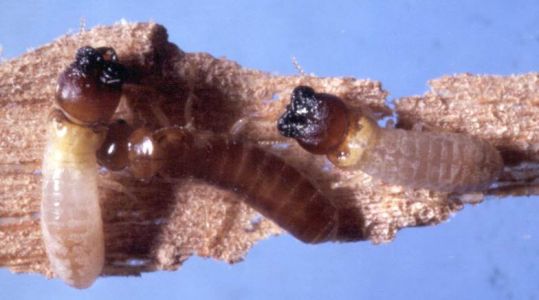
West Indian drywood termite soldier and worker © Queensland Government
Where are they found?
West Indian drywood termites are native to South America.
They were discovered in Sydney in the 1940s and are recorded as having occurred in parts of New South Wales (NSW), including harbourside suburbs of Greater Sydney and Newcastle, and coastal northern NSW.
They may be present in other parts of NSW and are established in Queensland.
How do they impact us?
West Indian drywood termites can cause severe structural damage to houses, other wooden buildings, and items made from timber, such as furniture. The galleries and tunnels they create within wood weaken its structural integrity.
Buildings with untreated timber frames - particularly those close to beaches, ports and marinas - are at risk of infestation and damage occurs slowly. West Indian drywood termites impact amenity, safety, and asset values by destroying:
- structural timber in homes and buildings, particularly older and often heritage-listed buildings that have untreated maple or red cedar framing
- timber furniture, picture frames and ornaments
- fences, and power poles
- cladding and flooring
- wooden boats.
What do West Indian Drywood Termites look like?
It can be difficult to identify West Indian drywood termites. They have a similar appearance to other species, such as:
- Native drywood termite (Cryptotermes primus)
- Indo-Malaysian drywood termite (C. cynocephalus), and
- Domestic drywood termite (C. domesticus).
Colonies are composed of a king, a queen, alates (the winged form), immature reproductive termites, and soldiers. The alates or soldiers are best used for species identification.
Alates (winged form):
- are most likely to be seen, as they are the only colony members to leave the timber
- have medium-brown bodies
- have hairless membranous wings, around 9mm long
- are about 11mm long (including wings)
- fly at night and are attracted to lights
- are weak flyers (slow and drifting, 60–200m per flight)
- on landing, they often detach their wings, which can collect around windows or in the corners of rooms.
Soldiers:
- have white bodies and dark heads that are plug-like and deeply wrinkled
- are 4–6mm long
- have heads about 1.4mm wide.
The NSW Department of Primary Industries and Regional Development provides a diagnostic service (fees apply) for termites and other insects. To facilitate identification, a sample should include a minimum of 10 soldiers and winged reproductives (alates) if present.
More information about how to submit a sample for identification can be found on this webpage under Plant health, pest & disease, insect identification.
How do they spread?
Colonies spread through swarming (up to 100 m) and through human assisted movement of contaminated timber products.
How can I prevent their introduction?
Different woods have different resistances to termite attack - for example, the use of softer, less dense woods will mean that structures are more susceptible to termite attack and will propagate infestation.
Untreated products made from the following species are particularly susceptible to West Indian drywood termite infestation:
- hoop pine (Araucaria cunninghamii)
- pine and pine hybrids (Pinus species)
- cabinet timbers such as
- maples (Flindersia species)
- red cedar (Toona ciliata)
- silky oak (Grevillea robusta).
Timber treated for subterranean termites and other insects in compliance with the Australian Timber Preservation Standards AS or AS/NZS 1604 series (Australian Standard 1604) is not at risk from drywood termites.
How can they be controlled?
To protect your property against West Indian drywood termites, obtain regular inspections by a licensed pest management technician. Building owners and occupiers have a legal obligation under the NSW Biosecurity Act 2015 to take all reasonable steps to prevent, eliminate and minimise the risk of spreading West Indian drywood termites. Obtain treatment if West Indian drywood termites are confirmed.
Spot treatment may be possible in certain situations, but structural fumigation of buildings (commonly known as ‘tenting’ or ‘tent fumigation’) is recognised as the most effective treatment for infested houses and buildings. Structural fumigation is a specialist service, and not all pest management technicians are authorised to conduct this activity.
Ask your pest management technician to provide evidence of their pest control licence, as required under the NSW Pesticides Regulation 1999. This licence must have endorsements for timber pests and fumigation with site environment specified.
The NSW Environment Protection Authority provides advice about engaging pest management technicians.
What are my legal responsibilities?
You have a general biosecurity duty under the NSW Biosecurity Act 2015 to take all reasonable steps to ensure you do not move or spread live drywood termites off your property. Infested timber and furniture should only be disposed of at an approved waste management facility once it has been treated using one of the following methods:
- fumigation treatment by a licensed pest management technician
- freezing for 24 hours at –18 degrees Celsius
- heat treatment to at least 49 degrees Celsius for at least 1 hour
- double wrapping with heavy duty plastic sheeting and sealing the ends and edges with heavy duty tape, then labelling as “infested with drywood termites, not to be reused”.
The pest management technician will advise whether treatments of contaminated timber can be completed on site or will need to be completed at a treatment facility.
Timber that has been fumigated, freezer-treated, heat-treated or wrapped can be moved to the nearest waste management facility that will accept timber waste. Check with the facility first.