
Report Lumpy Skin Disease
Report unusual disease signs, abnormal behaviour or unexplained deaths in livestock and other animals. Ring the 24 hour EAD hotline on 1800 675 888.
Lumpy skin disease (LSD) is a highly infectious viral disease that affects all breeds of cattle and water buffalo. It does not affect other types of livestock or humans. LSD is an exotic animal disease and Australia currently maintains a disease-free status for LSD.
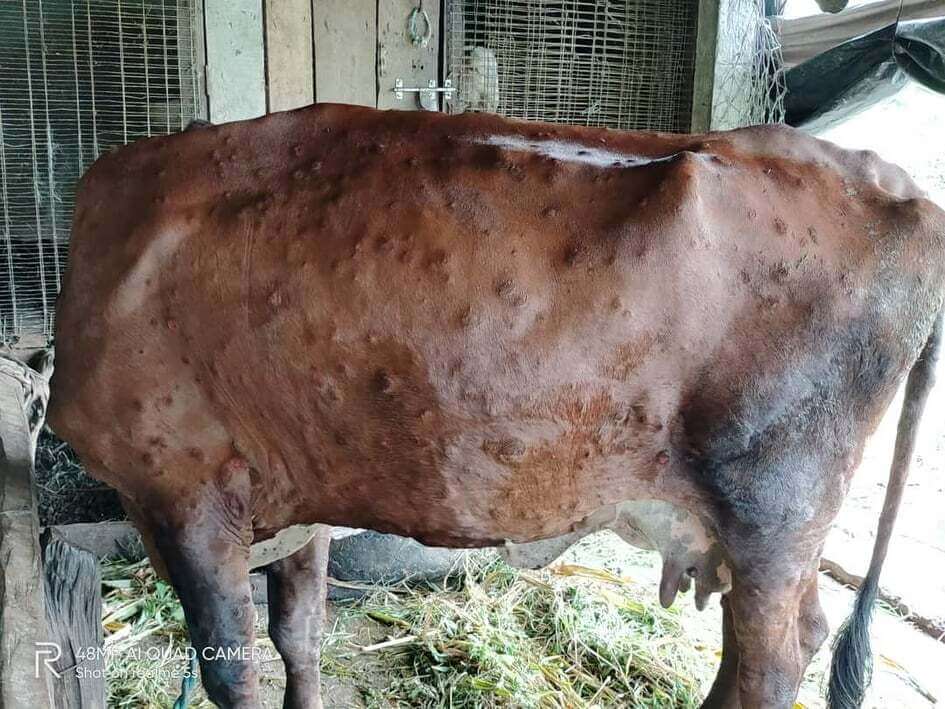
What does Lumpy Skin Disease (LSD) look like?
Clinical signs: animals infected with the disease present with fever, depression, and characteristic skin nodules. Once in a herd, the disease is very difficult to eradicate due to subclinical infections and the presence of insects capable of spreading the virus.
Clinical signs include:
- Firm raised skin nodules up to 50mm in diameter, distributed around the head, neck, genitals and limbs. Nodules can develop on any part of the body.
- Scabs develop in the centre of the nodules after which the scabs fall off, leaving large holes that may become infected.
- Swelling of limbs, brisket and genitals may occur
- Reluctance to move and eat
- Nasal and ocular discharges
- Enlarged superficial lymph nodes
- Drop in milk production
- Abortion.

Source: Center for Food Security and Public Health (CFSPH) at Iowa State University, College of Veterinary Medicine and Plum Island Animal Disease Center (PIADC). Noah’s Arkive, PIADC LSD_002

Source: Center for Food Security and Public Health (CFSPH) at Iowa State University, College of Veterinary Medicine and Plum Island Animal Disease Center (PIADC). Noah’s Arkive, PIADC LSD_001

Buffalo fly or lumpy skin disease?
This buffalo fly season, be aware of skin reactions that mimic lumpy skin disease (LSD) symptoms.
We are examining cattle in NSW saleyards due to the increased risk of LSD at our Australian border. If symptoms are observed at the saleyard, your cattle may be held for further testing before being released. During this time, additional expenses may be incurred by the owner, such as animal feeding and transport back to property of origin.
You can avoid this by contacting your Local Land Services District Veterinarian about any animals with skin reactions at least a week prior to sale. Your District Veterinarian can talk over your concerns, provide advice and examine your animals if needed to ensure sale day goes smoothly.
For more information, visit https://www.lls.nsw.gov.au/biosecurity/emergency-animal-disease
What should I do if I suspect Lumpy Skin Disease (LSD)?
If you suspect Lumpy Skin Disease in cattle or buffalo contact a veterinarian or call the Emergency Animal Disease Hotline immediately on 1800 675 888.
How is it diagnosed?
Notifiable disease testing is conducted by NSW DPI as a cost-free service to the submitter/owner.
Diagnosing LSD:
- A thorough clinical examination, carried out by a veterinarian, is considered as an effective surveillance tool for LSD.
- The incubation period is between 4 and 14 days; however, the OIE Terrestrial Animal Health Code describes the incubation period as 28 days.
- Skin nodules, scabs and crusts contain high amounts of LSD virus. Virus can be isolated from this material for 35 days and possibly longer.
- LSD virus is found in the blood (viraemia) from approximately 7-21 days post infection.
Typical post-mortem findings include:
- Extensive greyish-pink skin nodules with caseous necrotic centres.
- Similar nodules may be found in the nasopharynx, trachea, bronchi, lungs, rumen, abomasum, renal cortex, testicles and uterus.
- Swollen, congested lymph nodes with petechial haemorrhages.
Recommended samples to be collected from live cattle:
- 7-10mL/animal of serum and EDTA from a least 10 live, clinically affected animals and 10 in contact animals.
- Additionally, from clinically affected animals, one of the following samples should be taken for further PCR testing:
- Skin lesions: biopsies, scabs, scrapings or vesicular fluid, stored unpreserved, and/or
- Saliva and nasal swabs: dry swabs placed into PBGS or saline.
Recommended post-mortem samples to be collected:
- Fresh and fixed tissue from characteristic skin lesions,
- Internal lesions (if present), and
- Regional lymph nodes.
Transporting samples:
- Chill blood samples, swabs and unpreserved tissue samples at either 4°C or with ice bricks, do not freeze samples as it reduces the sensitivity of virus isolation testing.
- Place swab samples in transport media (PBGS) or in saline if other media is unavailable. PBGS can be obtained from the following:
- your local LLS District Veterinarian (1300 795 299),
- EMAI (1800 675 623), or
- EMAI Laboratory
- Send samples in appropriate packaging via courier to the NSW APHL:
NSW Animal and Plant Health Laboratories
Elizabeth Macarthur Agricultural Institute (EMAI)
Woodbridge Road
Menangle NSW 2568
Phone: 1800 675 623 - If you do not routinely dispatch samples to EMAI, contact laboratory customer service (1800 675 623, laboratory.services@dpird.nsw.gov.au) in advance for assistance with dispatch logistics.
How is it spread?
LSD is primarily spread by biting insects. Insects such as mosquitoes, biting flies and possibly ticks mechanically transfer the virus. It can also be spread through direct contact between animals via secretions and excretions. Contaminated feed, water, vehicles and iatrogenic means (for example, repeated use of needles on different animals) can all spread the disease. In addition, LSD may be shed in semen and may be present in milk of infected animals.
The incubation period for LSD is reported to be variable, as short as 6 days and as long as 28 days.
The geographical distribution of LSD has been rapidly expanding through southern Asia since 2021. Australia is on high alert for spread of the disease to Australia from the region. An incursion of LSD would have severe negative animal welfare and economic implications along with substantial trade impacts.
Does Lumpy Skin Disease (LSD) affect people?
Lumpy skin disease does not present a risk to humans. The consumption of meat, milk and other products from cattle is safe.
Other key information and resources
Prevention and management
Biting flies and mosquitoes as well as ticks play a major role in spreading LSD between animals on the farm and between farms. The best way to protect your cattle is by developing and implementing an integrated insect management plan. This involves targeting all stages of the stable fly and mosquito life cycles to break the breeding cycle. It also needs to consider tick control.
Effective insect management on-farm includes:
- Monitoring larval and adult fly and mosquito numbers to know when to take action
- Environmental management to reduce the number of breeding and resting site, e.g., fill potholes, remove standing water from containers, and ensure drains are free flowing
- Applying larvicide control in large bodies of water
- Applying adulticide control, such as residual spraying and fogging
- Maintaining chemical and mosquito control records
Note for vector control:
- Always use chemicals strictly as per the product label
- Seek professional advice if you are unsure about how to use a chemical
- Chemical residues in cattle are a trade and food safety risk
- Misuse of chemicals can pose risks to the environment (to bees, wildlife, aquatic life) and humans.
For more information on vector control for cattle, refer to:
Additional information for veterinarians
- Lumpy skin disease – information for vets PDF, 545.77 KB
- Animal Health Australia Website: Informing EAD Responses - AUSVETPLAN - Animal Health Australia – Lumpy skin disease response strategy
Additional information for cattle producers
Reporting animal biosecurity emergencies
Some animal pests and diseases, or residues in animal products or stock feed can have serious consequences for trade, production or human health. By remaining vigilant and acting quickly if you suspect a significant animal pest, disease, or residue you may be able to prevent these consequences. Don’t delay! Contact Local Land Services or ring the 24 hour hotline: