

Report Cattle Tick
Report unusual disease signs, abnormal behaviour or unexplained deaths in livestock and other animals. Ring the 24 hour EAD hotline on 1800 675 888.
Cattle ticks (Rhipicephalus (Boophilus) microplus) are a notifiable pest in NSW under the NSW Biosecurity Regulation 2017 and are subject to eradication measures.
For over 100 years, the NSW Government—working in cooperation with stock owners, the NSW Department of Primary Industries (DPI), and Local Land Services (LLS)—has operated a dedicated cattle tick program. The program’s goal is to prevent the entry of cattle ticks into NSW and to eradicate them whenever they are detected.
Cattle ticks are a serious concern due to their ability to transmit tick fever, a potentially fatal disease in cattle.
.
Disease information
What do Cattle ticks and Cattle tick infested cattle look like?
A cattle tick infestation is confirmed by the observation of ticks attached to an animal. Cattle ticks need to be differentiated from the other two tick species of concern in cattle being the paralysis tick (Ixodes holocyclus)and the bush tick (Haemaphysalis longicornis).
Cattle ticks favour cattle, but infestations also occur on buffalo, deer, camels, horses and sheep. Cattle ticks may occasionally be seen on donkeys and goats, but they are not found on marsupials or domestic pets. The period of peak activity for cattle ticks is February to June — later than for bush and paralysis ticks. This is important to consider when monitoring stock for ticks. In general terms, a tick found after February has a greater chance of being a cattle tick than a tick found before February, particularly if ticks are present in large numbers.
Adult ticks are the easiest stage to identify without the use of a microscope. They are the stage most commonly found in a physical examination of livestock. The key features to compare when trying to distinguish between adult bush, paralysis and cattle ticks are the legs, the body and the face. In particular, look for:
- Red legs on the bush tick
- Pale legs on a cattle tick
- A large, pointy snout with a variation in leg colour on paralysis ticks.
Refer to the NSW DPI Primefact, Ticks of concern to NSW stock owners PDF, 132.64 KB, for more detail on the identification of cattle tick
What should I do if I suspect Cattle tick infested cattle?
If you suspect tick fever you must notify either Local Land Services (1300 795 299) or the Department of Primary Industries (animal.biosecurity@dpird.nsw.gov.au) within one working day.
How is it diagnosed?
A diagnosis of cattle tick is confirmed by visual examination (in situ or after collection) of ticks by a NSW DPI or Local Land Services representative.
If a stock owner or livestock agent suspects cattle ticks on any animal, they should contact either Local Land Services (1300 795 299) or the Emergency Animal Disease hotline (1800 675 888).
If a veterinarian or NSW DPI authorised officer is required to collect ticks to confirm a cattle tick diagnosis, refer to the following relevant NSW DPI Primefacts:
How is it spread?
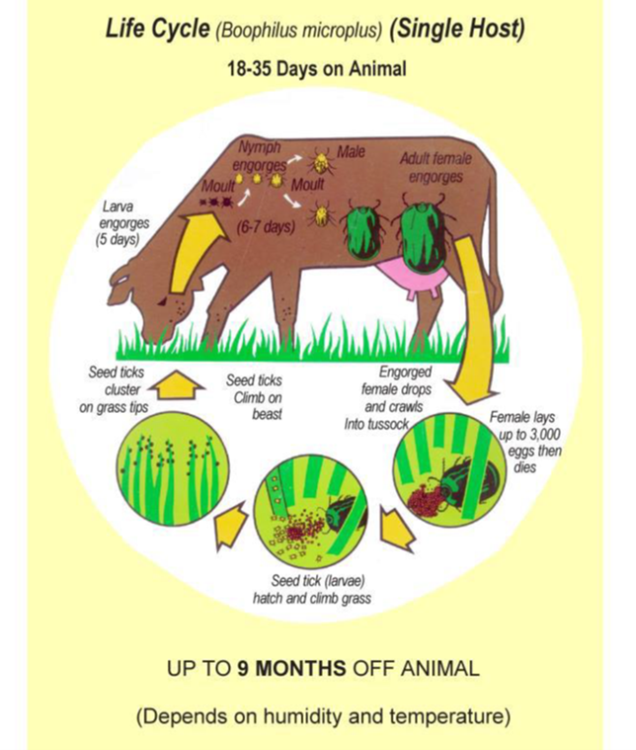
Cattle ticks stay on the one host throughout the parasitic phase from larvae to nymph to adult and for this reason thet are often referred to as ‘one-host ticks’. Eggs and larvae survive in pasture for up to 9 months while the parasitic phase on the animal is only about 3 weeks. During the parasitic phase when they suck blood from a host, the ticks moult through three stages, each stage lasting about a week:
- Pinhead sized larvae (‘seed ticks’)
- Matchhead sized nymphs
- Matchhead to pea-sized adult females.
Transmission from animal to animal occurs via the pasture phase, whereby an engorged female tick drops off the host, eggs are subsequently laid on pasture, hatch and hatched seed ticks attach to grazing animals (see Figure 1).
Do Cattle tick affect people?
Cattle tick are not of concern to humans.
Other key information and resources
Cattle tick control
Cattle ticks are subject to eradication efforts whenever they are found in NSW. Eradication is an option for cattle ticks because unlike the other 2 ticks they stay on the one animal for 3 weeks during the parasitic phase and they don’t attach to native animals.
Managing cattle for any type of tick involves:
- Reducing the tick risk;
- Possible preventative treatments;
- Monitoring your herd;
- Possible control or eradication treatments.
For additional information on control, see the NSW DPIRD Primefact, Ticks of concern to NSW stock owners PDF, 132.64 KB.
Additional information
NSW DPIRD Cattle Tick Resources
Cattle tick – collection and storage of suspect cattle ticks found on livestock PDF, 6214.91 KB
Reporting animal biosecurity emergencies
Some animal pests and diseases, or residues in animal products or stock feed can have serious consequences for trade, production or human health. By remaining vigilant and acting quickly if you suspect a significant animal pest, disease, or residue you may be able to prevent these consequences. Don’t delay! Contact Local Land Services or ring the 24 hour hotline: